



What's Happening?
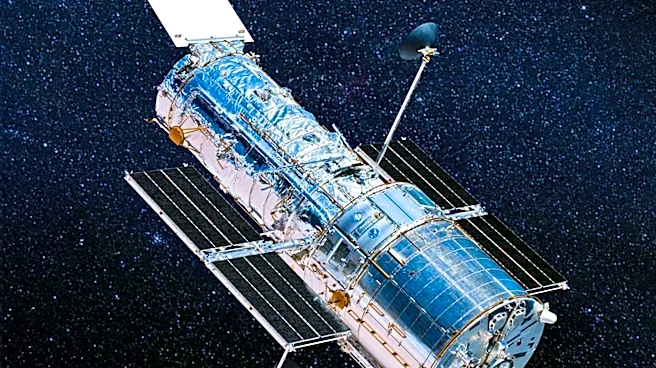
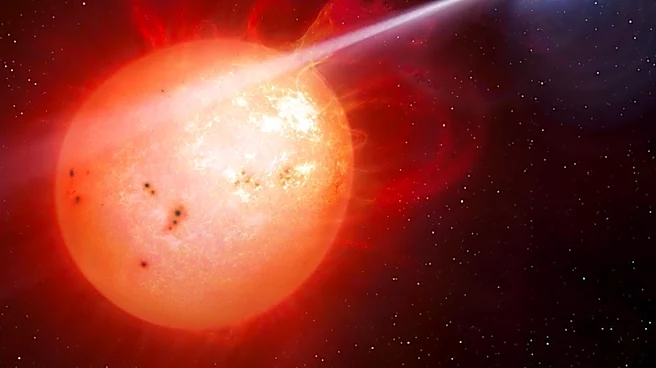
Astronomers utilizing data from NASA’s Hubble Space Telescope have identified a surprising chemical signature around the white dwarf star HS 0209+0832, suggesting the presence of a 'second-generation' planet. This planet, if confirmed, would have formed
from material ejected by the star as it died, rather than from the initial stellar birth. The key clue is the unusually high abundance of the element niobium, which was detected in archival Hubble data from 1999. Initially, about 100 chemical features in the data were unidentifiable, but with updated chemical databases, niobium was found to match many of these mystery features. Niobium and other heavy elements are typically synthesized in the exotic conditions that emerge inside dying stars, indicating that the material forming this potential planet originated from the star's death throes. The research team confirmed these observations with data from NASA's retired FUSE (Far Ultraviolet Spectroscopic Explorer) mission and also used NASA’s TESS (Transiting Exoplanet Survey Satellite) to observe periodic brightness variations, suggesting a gas giant planet, roughly Jupiter-sized, orbiting at about 3.7 million miles from the white dwarf.
Why It's Important?
This discovery challenges the traditional understanding of planetary system evolution, suggesting that the death of a star might not be an end but a new beginning for planetary formation. Earth and other planets in our solar system are considered 'first-generation' planets, forming from the material left over from a star's birth. The potential existence of a second-generation planet around a white dwarf star, a stellar remnant, opens up new avenues for astrophysical research and could redefine our understanding of where and how planets can form. It implies that planetary systems can be more varied and complex than previously thought, even after their host star has ceased nuclear fusion. This paradigm shift could lead to investigations into the potential habitability of such second-generation planetary systems in the future, expanding the scope of exoplanet research and the search for life beyond our solar system. The ongoing observations by Hubble and other missions are crucial for confirming this finding and understanding the dynamics of such unique systems.
What's Next?
The research team plans to continue observing the HS 0209+0832 system using the Hubble Space Telescope and NASA's Chandra X-ray Observatory over the next year. They have also requested observation time with the more powerful James Webb Space Telescope, which could provide additional insights into the existence and characteristics of this suspected second-generation planet. Further observations are needed to confirm the planet's presence and to understand the processes of its formation and evolution. Astronomers aim to build substantial data and statistics on these new types of celestial bodies to determine how common or rare they are and how they evolve in orbit around a 'dead' star. The current understanding suggests that while the white dwarf is still hot and stripping the planet's atmosphere, the planet is likely to survive, potentially entering a stable habitable zone for millions of years once the white dwarf cools.
Beyond the Headlines
The identification of a potential second-generation planet introduces a profound shift in our cosmic narrative, suggesting that the life cycle of a star and its planetary system is far more intricate and cyclical than previously imagined. This finding extends beyond mere astronomical observation; it touches upon the fundamental questions of planetary genesis and the conditions under which life might arise. If planets can form from the remnants of a dying star, it implies a resilience and adaptability in the universe's creative processes. This could lead to a re-evaluation of exoplanet search strategies, potentially broadening the types of stellar systems considered viable for hosting planets, and by extension, life. The ethical and philosophical implications are significant, as it suggests that even in stellar death, new worlds can be born, offering a continuous cycle of creation and potentially, habitability, across vast cosmic timescales. This discovery underscores the dynamic nature of the universe and the ongoing potential for unexpected phenomena to reshape our scientific understanding.