





What's Happening?
John Wallace, an associate professor of weed science in Penn State’s College of Agricultural Sciences, has been named the new director of the Penn State Regenerative Agriculture Center. This center, with its research activities primarily based on a 125-acre
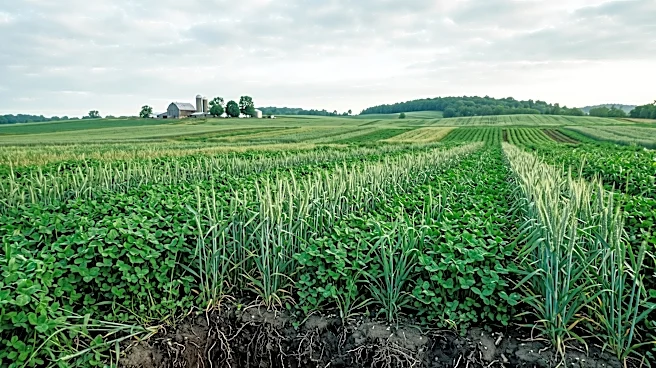
property at Rockview in Centre County, will serve as a living laboratory for field-scale research, demonstrations, and education. Regenerative agriculture encompasses practices such as cover cropping, reduced tillage, diverse crop rotations, and integrated livestock systems. The goal of this approach is to improve soil health, protect natural resources, and strengthen the long-term viability of agricultural operations while maintaining farm productivity and profitability. Wallace's expertise in weed science and sustainable cropping systems, coupled with his strong relationships with growers and agricultural industry professionals, positions him to lead the center's efforts in advancing regenerative farming practices across Pennsylvania. His previous work includes directing an organic cropping systems research project focused on reducing tillage in organic grain production through diversified crop rotations and intensive cover crop management.
Why It's Important?
The appointment of John Wallace and the focus of the Penn State Regenerative Agriculture Center are significant for the future of U.S. agriculture, particularly in Pennsylvania. By promoting regenerative farming practices, the center aims to address critical environmental and economic challenges faced by farmers. Improved soil health, a core tenet of regenerative agriculture, can lead to increased water retention, reduced erosion and runoff, and enhanced nutrient cycling, which are vital for long-term agricultural sustainability. This initiative can also bolster the economic viability of farms by potentially reducing reliance on synthetic inputs and improving crop resilience. For consumers, the adoption of these practices could lead to more sustainably produced food. The center's emphasis on research, demonstration, and education will provide farmers with science-based solutions and practical guidance, fostering a broader transition towards more environmentally friendly and economically sound agricultural methods across the region.
What's Next?
Under John Wallace's leadership, the Penn State Regenerative Agriculture Center is expected to strengthen partnerships among researchers, Penn State Extension educators, farmers, and agricultural industry partners. The center will continue to conduct field-scale research and demonstrations at its Rockview site, serving as a hub for innovation and knowledge dissemination. Future efforts will likely focus on developing best management practices for various cropping systems, particularly in reduced-tillage environments, and exploring opportunities for farmers to access food- and feed-grade markets. The center will also play a role in addressing challenges such as herbicide-resistant weeds through integrated weed management and precision technologies. The ongoing research and educational initiatives are anticipated to drive the adoption of regenerative practices, contributing to improved farm productivity, profitability, and environmental stewardship throughout Pennsylvania and potentially beyond.
Beyond the Headlines
The establishment and direction of the Penn State Regenerative Agriculture Center reflect a broader national and global shift towards more sustainable food systems. Beyond the immediate benefits of improved soil health and farm viability, regenerative agriculture has deeper implications for climate change mitigation through carbon sequestration in soil. While the extent and permanence of carbon storage are still subjects of ongoing research, the practices promoted by the center offer a promising pathway for agriculture to contribute positively to environmental goals. The center's work also highlights the evolving role of agricultural research institutions in providing practical, science-based solutions that bridge the gap between academic knowledge and on-farm application. This integrated approach, combining research, extension, and farmer collaboration, is crucial for fostering systemic change in agricultural practices and addressing complex challenges related to food security, environmental protection, and rural economic development.