







What's Happening?
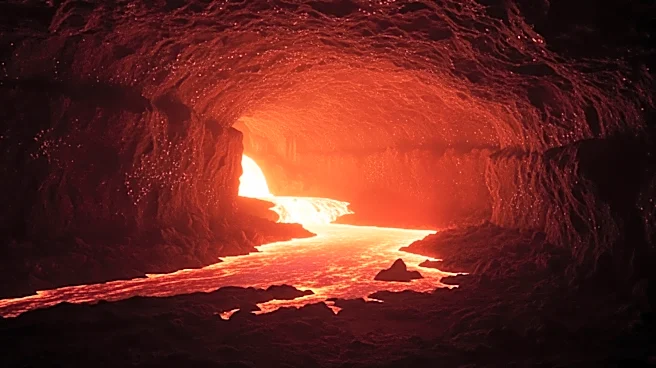
Planetary scientists have confirmed the existence of a large volcanic cave beneath Venus's surface, marking the first direct evidence of intact underground lava tunnels on the planet. This discovery, published in Nature Communications, was made using
radar data from NASA's Magellan spacecraft. The radar revealed a hollow space beneath the crust near Nyx Mons, a volcanic rise on Venus. The identified lava tube is significantly larger than those on Earth, with a roof over 490 feet thick and an internal chamber rising over 1,230 feet. This finding provides new insights into Venusian volcanism and surface formation.
Why It's Important?
The discovery of a massive lava tube on Venus offers a tangible target for future exploration and validates long-standing theories about the planet's geological features. Understanding these structures can provide insights into Venus's volcanic history and the processes that shape its surface. The presence of such large underground passages suggests that Venus's lower gravity and dense atmosphere may allow for the formation of extensive lava networks, which could have implications for the planet's geological evolution and potential for past or present volcanic activity.
What's Next?
Upcoming missions, including ESA's EnVision orbiter and NASA's VERITAS mission, aim to further explore Venus's subsurface structures. These missions will use advanced radar technology to map the planet with unprecedented resolution, potentially revealing more about the extent of underground lava networks. The findings could transform our understanding of Venusian geology and guide future exploration efforts, offering new opportunities to study the planet's volcanic activity and its implications for planetary science.