







What's Happening?
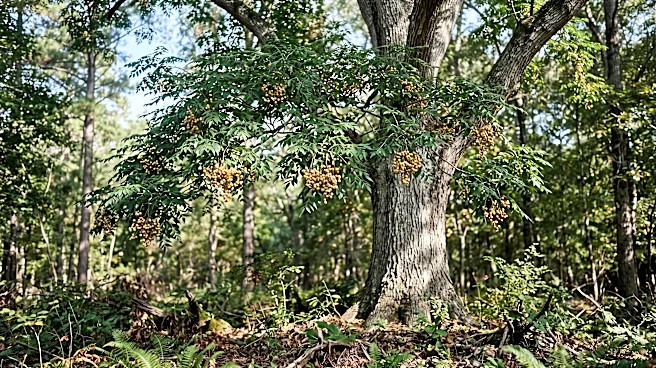
The chinaberry tree, originally brought to the United States in 1830 as an ornamental plant for its aesthetic appeal, has become a significant invasive species across approximately 101,000 acres of Southern U.S. forests. Initially planted in coastal Georgia
and South Carolina, its ease of growth and ability to form colonies from root suckers, root collar sprouts, and seedlings allowed it to escape cultivated gardens and spread into wild areas. According to a USDA Forest Service technical report by Miller, Chambliss, and Loewenstein (2010, revised 2012, 2013, and 2015), the chinaberry is now a common invasive plant, posing a concern for foresters almost 200 years after its introduction. Its rapid proliferation highlights the long-term ecological consequences of introducing non-native species without fully understanding their potential impact on local ecosystems.
Why It's Important?
The widespread invasion of the chinaberry tree in Southern U.S. forests underscores the critical importance of understanding the ecological impact of introduced species. Invasive plants can outcompete native flora, disrupt local ecosystems, and reduce biodiversity, leading to significant environmental and economic costs. For the U.S., particularly in the Southern states, this invasion can affect timber production, wildlife habitats, and the overall health of forest ecosystems. The USDA Forest Service's ongoing monitoring and reporting on such species are vital for developing strategies to manage and mitigate the damage caused by invasive plants. This situation serves as a historical lesson on the need for rigorous assessment before introducing non-native species, even those intended for ornamental purposes, to prevent future ecological challenges.
What's Next?
Addressing the chinaberry invasion will likely involve continued efforts by the USDA Forest Service and state forestry departments to manage and control its spread. This could include developing and implementing strategies for removal, such as mechanical or chemical treatments, and promoting the planting of native species. Research into more effective and environmentally sound methods for controlling invasive plants will also be crucial. Furthermore, this case may influence future policies regarding the introduction of non-native plants, potentially leading to stricter regulations and more comprehensive ecological impact assessments to prevent similar situations from arising with other species. Public awareness campaigns could also play a role in educating homeowners about the risks of planting invasive ornamental trees.
Beyond the Headlines
The chinaberry tree's journey from an ornamental garden plant to an ecological threat highlights a broader issue of human-induced environmental change. It illustrates how seemingly innocuous actions, like planting a beautiful tree, can have profound and unforeseen long-term consequences on natural landscapes. This situation raises ethical questions about human responsibility in shaping ecosystems and the need for a more holistic understanding of ecological interconnectedness. It also points to the challenge of balancing aesthetic preferences with ecological preservation, a dilemma that continues to face land managers and policymakers. The ongoing struggle against invasive species like the chinaberry is a testament to the enduring impact of historical decisions on contemporary environmental health.