




What's Happening?
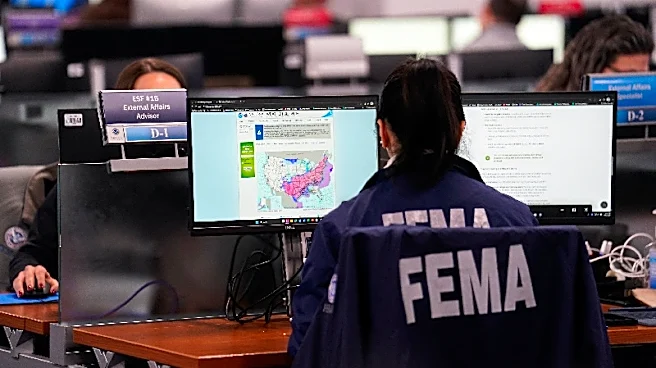
A federal judge has ruled that a Trump administration order to significantly reduce staffing at the Federal Emergency Management Agency (FEMA) was illegal. U.S. District Judge Susan Illston in Northern California stated that the Department of Homeland
Security (DHS) acted 'arbitrarily and capriciously' when it revoked FEMA's authority to renew contracts for its on-call disaster response teams, known as CORE. These teams constitute approximately 40% of FEMA's workforce and are crucial for initial disaster response and aid distribution. Traditionally, CORE workers had contracts renewed for two to four years, but in 2025, DHS limited renewals to 180 days as part of a broader effort to downsize the federal government. In January, DHS instructed FEMA to allow some of these contracts to lapse, aiming to force employees out. The judge also criticized the use of the secure messaging app Signal by former acting FEMA head Karen Evans and former DHS deputy chief of staff Joseph Guy, noting that messages relevant to the case were set to auto-delete, violating federal law and department policy. Evans, who previously served as DHS Chief Information Officer, was found to have intentionally deleted messages.
Why It's Important?
This ruling is a significant victory for union workers and underscores the legal limits on executive branch actions concerning federal agencies. The decision highlights the importance of FEMA's CORE teams, which are often the first federal responders to major disasters like hurricanes, providing essential aid and long-term funding to affected states and communities. The Trump administration's attempt to drastically cut FEMA's workforce, despite a 2023 Government Accountability Office report indicating a staffing shortfall of over 6,000 employees, could have severely hampered the nation's disaster response capabilities. The judge's finding that DHS acted 'arbitrarily and capriciously' reinforces the legal principle that government agencies must provide reasoned justifications for their decisions. Furthermore, the criticism regarding the use of Signal and the deletion of messages by high-ranking officials raises concerns about transparency, accountability, and adherence to federal record-keeping laws within government operations. This could set a precedent for future cases involving the use of ephemeral messaging apps by federal employees.
What's Next?
While the judge ruled the Trump administration's order illegal, she did not specify remedies, instead ordering the parties to agree on the scope of relief. The labor unions that brought the lawsuit, the American Federation of Government Employees and the AFL-CIO, had sought the rescission of all non-renewal notices for CORE employees and their reinstatement, along with a halt to the plan to cut 50% of FEMA's staff. However, the judge noted that FEMA is no longer systematically not renewing CORE contracts and is not currently acting on the 50% staff cut plan. Nevertheless, DHS continues to limit FEMA's authority by ordering contracts of up to 180 days. Future proceedings will likely focus on determining appropriate remedies for the past actions and ensuring DHS does not continue to usurp FEMA's authority in contract renewals. The court will also presume that the deleted Signal messages would have been unfavorable to the defendants, which could impact future arguments and potential penalties.
Beyond the Headlines
The ruling extends beyond the immediate issue of FEMA staffing, touching upon broader themes of executive power, administrative law, and government transparency. The Trump administration's push to downsize federal agencies and shift responsibilities to states reflects a long-standing ideological debate about the role and size of the federal government. This case demonstrates the judiciary's role in checking executive actions that may overstep legal boundaries or disregard established legislative mandates, such as the 2006 law protecting FEMA's authorities. The controversy surrounding the use of Signal by federal officials highlights the ongoing challenge of maintaining government records and ensuring accountability in the digital age, especially with the proliferation of encrypted and auto-deleting communication tools. This could lead to increased scrutiny and potentially new regulations regarding how federal employees conduct official communications, impacting future administrations and their interactions with federal agencies.