



What's Happening?
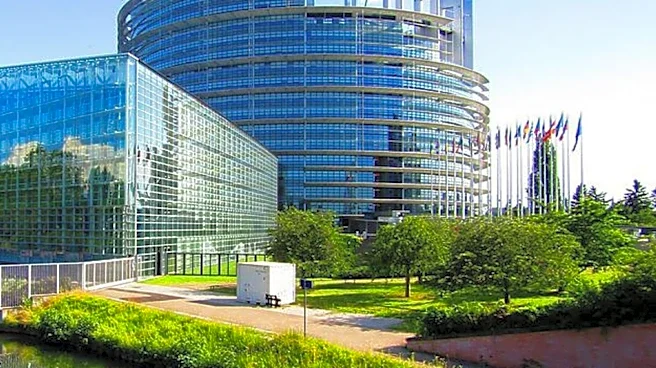
The European Parliament has adopted a resolution strongly condemning Russia's actions concerning Ukrainian children, including deportation, forced transfer, illegal adoption, forced Russification, indoctrination, and militarization. The resolution passed
with significant support, receiving 536 votes in favor, 8 opposed, and 37 abstentions. MEPs asserted that those responsible for these actions must be held accountable. As of September 2026, at least 20,651 cases of deported Ukrainian children have been formally verified, with an estimated 1.6 million children remaining under Russian occupation. The Parliament called for the immediate, safe, and unconditional return of all deported and forcibly transferred Ukrainian children, emphasizing that this is an obligation under international law and should not be used as a negotiating tool.
Why It's Important?
This resolution from the European Parliament highlights a critical humanitarian crisis and a grave violation of international law. The forced deportation and Russification of Ukrainian children represent war crimes, as recognized by the International Criminal Court (ICC) through arrest warrants issued against Russian President Vladimir Putin and Maria Lvova-Belova. The Parliament's strong condemnation and call for accountability underscore the international community's commitment to protecting vulnerable populations during conflict. The emphasis on the unconditional return of children signifies that their well-being is paramount and should not be leveraged for political gain. This stance reinforces the principle that such actions are unacceptable and demand a unified international response, potentially influencing future diplomatic efforts and sanctions against Russia.
What's Next?
The European Parliament's resolution calls for enhanced cooperation among EU member states, Ukraine, international partners, and organizations like Europol and Eurojust to identify, document, trace, and return missing and deported Ukrainian children. It also advocates for expanding existing EU sanctions against officials and entities involved in these child deportations. The resolution supports the ongoing activities of the International Criminal Court (ICC) and its arrest warrants, pushing for accountability not only for Russia's senior leadership but for all individuals involved in these crimes. Continued diplomatic efforts will likely focus on pressuring Russia to comply with international law and facilitate the return of these children, with the issue remaining a central point in any peace negotiations.
Beyond the Headlines
The issue of deported Ukrainian children extends beyond immediate humanitarian concerns, touching upon profound ethical and legal dimensions. The forced Russification and indoctrination of these children represent an attempt to erase their cultural identity and integrate them into Russian society, which could have long-lasting psychological and social impacts. This systematic approach raises questions about cultural genocide and the deliberate targeting of a future generation. The Parliament's resolution, by highlighting these aspects, aims to prevent the normalization of such practices and to ensure that the rights of children are protected even in times of war. The long-term challenge will be the reintegration and rehabilitation of these children, many of whom may have experienced trauma and identity confusion, requiring extensive international support and specialized programs.