








What's Happening?
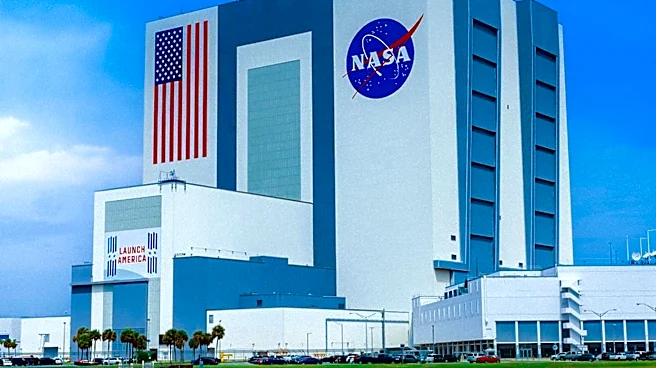
NASA's Nancy Grace Roman Space Telescope has arrived at the Kennedy Space Center in Florida, marking a significant step towards its anticipated launch. The observatory, weighing nearly 18,000 pounds, was transported from NASA's Goddard Space Flight Center in Maryland
to Florida. It is now undergoing final preparations, including cleaning, testing of its six solar panels, inspection of thermal protection systems, and loading of hydrazine fuel. The telescope is scheduled to launch aboard a SpaceX Falcon Heavy rocket no earlier than August 30th. Once in space, it will travel to the Sun-Earth L2 Lagrange point, where it will use its advanced instruments to survey billions of galaxies, discover exoplanets, and explore cosmic phenomena.
Why It's Important?
The Roman Space Telescope represents a major advancement in space exploration and astronomy. Its mission is expected to provide unprecedented insights into the universe, potentially challenging existing theories about galaxies, planets, and cosmic forces. The data collected could significantly enhance our understanding of the universe's expansion and the distribution of planets in the Milky Way. This mission underscores NASA's commitment to exploring fundamental questions about the cosmos and could lead to groundbreaking discoveries that reshape our understanding of space.
What's Next?
Following its arrival in Florida, the Roman Space Telescope will undergo extensive processing and inspections to ensure it is ready for launch. The mission is on track to launch by the end of summer, approximately eight months ahead of initial projections. Once operational, the telescope will begin its mission to collect vast amounts of data, which scientists will analyze to uncover new cosmic phenomena and deepen our understanding of the universe.