




What's Happening?
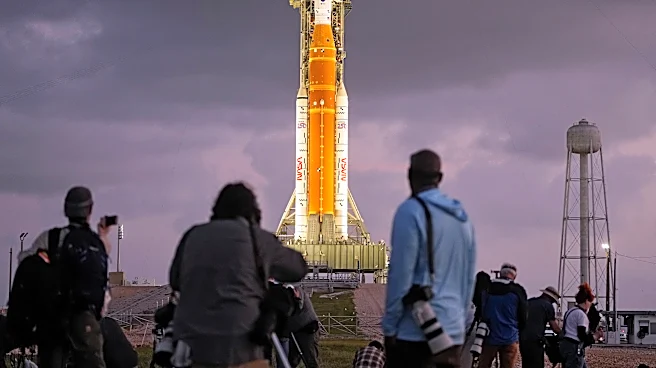
NASA's Artemis II mission, the first crewed lunar mission since 1972, is currently underway with astronauts Reid Wiseman, Victor Glover, Christina Koch, and Jeremy Hansen aboard. During the mission, an amusing incident occurred when astronaut Victor Glover took
a 'bath' on camera after his workout, providing a rare glimpse into the daily life of astronauts in space. The event took place on April 3, 2026, as the crew travels on a 10-day journey around the moon. The video feed from the Orion spacecraft was briefly cut when Glover removed his shirt, prompting a light-hearted response from Mission Control. The mission, which launched on April 1, is set to return to Earth on April 10, with the crew becoming the farthest humans from Earth when they loop around the moon on April 6.
Why It's Important?
The Artemis II mission is a significant step in NASA's efforts to return humans to the moon and eventually pave the way for future missions to Mars. The incident involving Victor Glover highlights the human aspect of space travel, offering the public a more relatable view of astronaut life. This mission is crucial for testing systems with a crew, which is essential for ensuring the safety and success of future deep-space missions. The public's engagement with such moments can increase interest and support for space exploration initiatives, potentially influencing funding and policy decisions related to NASA's long-term goals.
What's Next?
As the Artemis II mission progresses, the crew will continue to test the spacecraft's systems and conduct various experiments. The mission's success will be evaluated upon their return, with insights gained informing the planning and execution of subsequent Artemis missions. These future missions aim to establish a sustainable human presence on the moon and prepare for human exploration of Mars. Stakeholders, including NASA, international partners, and the scientific community, will closely monitor the outcomes to refine strategies for upcoming space exploration endeavors.
Beyond the Headlines
The Artemis II mission not only advances technological and scientific objectives but also carries cultural and inspirational significance. By showcasing the human side of space travel, such as the 'bath' incident, NASA can foster a deeper connection with the public, inspiring future generations to pursue careers in science, technology, engineering, and mathematics (STEM). Additionally, the mission underscores the importance of international collaboration in space exploration, as demonstrated by the inclusion of Canadian astronaut Jeremy Hansen, highlighting the global nature of space endeavors.