







What's Happening?
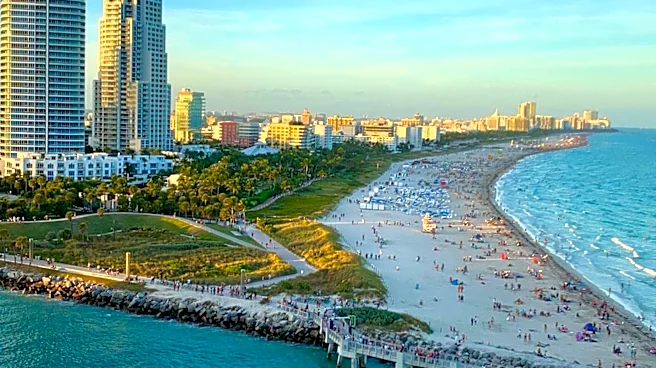
Miami-Dade County is experiencing unprecedented levels of sargassum, a type of floating brown algae, washing ashore on its 17 miles of beaches. Chris Bumpus, Chief of Conservation for Miami-Dade County's parks department, reports that 9,000 tons of seaweed
were removed in July alone, marking a record for a single month. This surge is part of a larger phenomenon, with the Great Atlantic Sargassum Belt, stretching from West Africa to the Gulf of Mexico, reaching its second-highest biomass on record this summer at 33.5 million tons. Scientists attribute the proliferation to several factors, including increased nitrogen and phosphorus runoff from major rivers like the Amazon and Mississippi, warmer ocean temperatures, and altered ocean circulation patterns, all exacerbated by climate change.
Why It's Important?
The escalating sargassum problem has significant environmental, economic, and public health implications for Miami-Dade County and other affected regions. Environmentally, while sargassum provides critical open-ocean habitat, its excessive accumulation near shore can create 'dead zones' by stripping oxygen from the water, harming coral reefs and seagrass beds. Economically, the cost of removal is substantial, with Miami-Dade County spending $3 million annually, funded by tourist development taxes. This impacts the tourism industry, a vital part of Florida's economy, as beaches become less appealing. Public health concerns arise from the hydrogen sulfide odors emitted by decaying sargassum, which can pose health risks. The situation underscores the direct and tangible impacts of climate change and nutrient pollution on coastal communities, demanding more aggressive and sustainable management strategies.
What's Next?
Miami-Dade County is actively seeking more flexible solutions for sargassum removal, with county commissioners voting in July to petition the state for permission to use beach raking equipment in more areas. Currently, federal and state regulations prohibit open-water sargassum removal due to concerns for marine life, though research suggests that sargassum loses much of its marine life as it approaches the shore. This research could potentially lead to changes in policy regarding offshore removal. However, experts like Brian LaPointe emphasize that while aggressive removal addresses symptoms, long-term solutions must focus on mitigating the underlying causes, such as land-based nutrient sources. This suggests a future focus on both immediate cleanup efforts and broader environmental policy changes to combat climate change and reduce pollution.
Beyond the Headlines
The sargassum crisis in Miami-Dade County is a stark illustration of how global environmental changes manifest at a local level, impacting daily life and economies. It highlights the interconnectedness of ecosystems, where distant river pollution and warming oceans contribute to problems thousands of miles away. The debate over removal methods versus addressing root causes also reflects a broader societal challenge in tackling climate change: whether to focus on adaptation and mitigation or on fundamental systemic changes. Furthermore, the financial burden on local governments, funded by tourism, creates a feedback loop where environmental degradation directly impacts the economic resources available to combat it. This situation calls for a holistic approach involving international cooperation, scientific research, and policy reforms to manage nutrient runoff and address climate change, recognizing that the 'new normal' of increased sargassum will require sustained and comprehensive efforts.