
What's Happening?
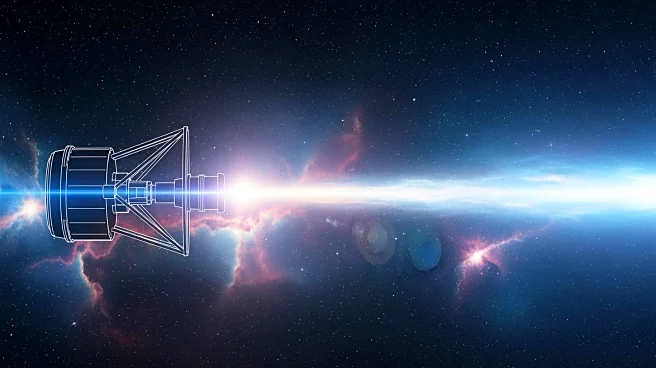
The Hubble Space Telescope has observed an infant star, 20 times larger than the sun, emitting a stellar jet traveling at 2.2 million miles per hour. This jet, the longest ever seen from a forming star, stretches
32 light-years, illuminating interstellar clouds HH 80 and HH 81. The star, IRAS 18162-2048, is located 5,500 light-years away and is the most massive protostar in its molecular cloud. The jet's speed and length make it a unique observation, providing insights into the behavior of massive young stars.
Why It's Important?
This discovery is crucial for understanding the formation and evolution of massive stars. The observation of such a long and fast jet provides valuable data on the dynamics of protostars and their interaction with surrounding interstellar material. It also highlights the capabilities of the Hubble Space Telescope in capturing detailed images of distant cosmic phenomena, reinforcing its role as a vital tool for astronomers even after decades of service.