





What's Happening?
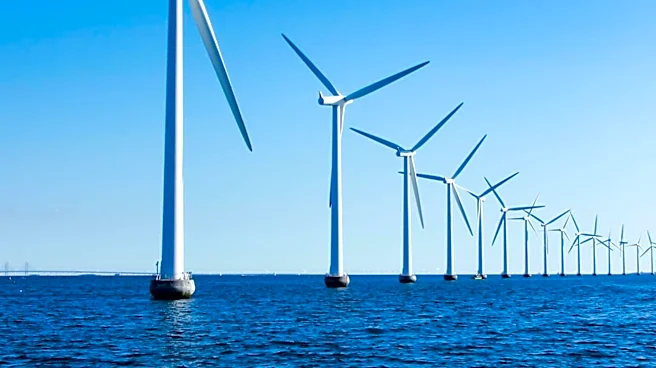
The global offshore wind energy market is projected to reach $189.7 billion by 2035, growing from an estimated $78 billion in 2024. This significant expansion is fueled by global decarbonization strategies, supportive government policies, and technological
advancements. Key drivers include the European Union’s REPowerEU framework, targeting over 110 GW of installed offshore capacity by 2030, and the U.S. Inflation Reduction Act, which extends investment tax credits for qualifying projects through 2032. The market is also undergoing a fundamental technological transition, moving from 6-8 MW fixed-bottom monopiles to 15-18 MW direct-drive units and semi-submersible floating substructures capable of operating in deeper waters. This leap in turbine capacity is reducing the levelized cost of energy (LCOE), which fell 34% between 2010 and 2023.
Why It's Important?
This growth signifies a critical shift in global energy production towards renewable sources, with substantial implications for the U.S. energy sector. The U.S. Bureau of Ocean Energy Management (BOEM) completed the Central Atlantic lease auction in February 2024, expanding federally leased acreage for future solicitations, indicating a strong commitment to offshore wind development. North America is projected to be the third-largest market, propelled by state-level procurement mandates in New York, New Jersey, and Massachusetts, and tax credits under the Inflation Reduction Act. This expansion will create new jobs, stimulate investment in port infrastructure (e.g., New Bedford and Portsmouth), and contribute to energy independence. The shift to larger turbines and floating technologies will also drive innovation in manufacturing and engineering, positioning the U.S. to become a leader in advanced offshore wind solutions.
What's Next?
The offshore wind market is expected to continue its rapid expansion, driven by ongoing policy support and technological innovation. Governments are increasingly issuing contracts rather than just setting targets, providing greater certainty for project financing. The U.S. will likely see continued lease auctions and state-level procurement mandates, leading to more projects entering the construction phase. Further reductions in LCOE are anticipated as larger turbines and floating technologies achieve commercial scale, making offshore wind more competitive with traditional energy sources. Investment in supply chain development, including specialized vessels and manufacturing facilities, will be crucial to support the growing number of projects. The market will also focus on overcoming challenges related to grid integration and environmental permitting to ensure smooth project execution.
Beyond the Headlines
The rapid growth of the offshore wind market has deeper implications beyond energy production. It represents a significant step towards energy security and climate resilience, reducing reliance on fossil fuels and mitigating greenhouse gas emissions. The development of floating offshore wind technology, in particular, opens up vast new areas for wind farm deployment in deeper waters, expanding the potential for renewable energy generation globally. This also fosters international collaboration in research and development, as countries share expertise in complex engineering and environmental management. However, it also presents challenges, such as potential impacts on marine ecosystems and fishing industries, requiring careful planning and stakeholder engagement. The long-term success of this market will depend on balancing economic growth, environmental protection, and social acceptance.