

What's Happening?
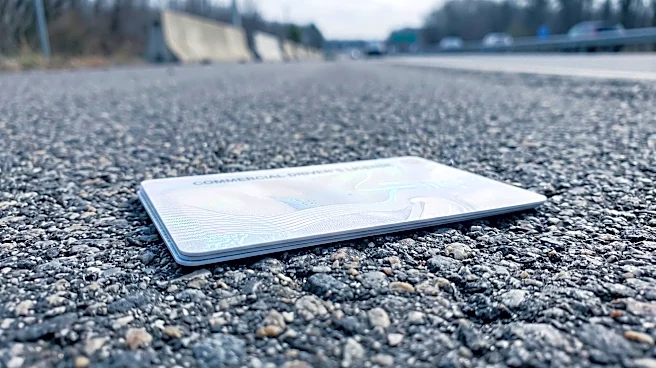
Missouri Governor Mike Kehoe has called on Illinois Governor J.B. Pritzker to review commercial driver's license (CDL) procedures after a deadly semi-truck crash in Kansas City. The incident involved Eldar Skander, a Ukrainian national identified by Homeland
Security as being in the U.S. illegally, who was driving a semi with a non-domiciled commercial license issued by Illinois in March 2025. Authorities reported that Skander's truck collided with stopped traffic on U.S. Highway 71, resulting in the deaths of a 35-year-old mother and her two young sons. Skander now faces three counts of involuntary manslaughter. Governor Kehoe emphasized that failures in licensing procedures can have severe consequences that extend beyond state borders, highlighting the need for a thorough review of how such licenses are issued.
Why It's Important?
Governor Kehoe's request to Governor Pritzker underscores a critical interstate issue concerning commercial driver's license regulations and their potential impact on public safety. The incident highlights a potential loophole or inadequacy in the current licensing system, particularly regarding non-domiciled commercial licenses and the verification of a driver's legal status. If individuals who are in the U.S. illegally can obtain CDLs, it raises significant questions about the integrity of the licensing process and the safety of roadways. This event could prompt a broader examination of CDL issuance policies across states, potentially leading to stricter verification requirements and enhanced inter-state cooperation on driver background checks. The tragic loss of life in Kansas City serves as a stark reminder of the severe consequences when regulatory oversight in such critical areas is perceived to be lacking, affecting not only the immediate families but also public trust in transportation safety.
What's Next?
Following Governor Kehoe's call, the immediate next step would likely involve Illinois Governor J.B. Pritzker's office initiating a review of the state's commercial driver's license (CDL) issuance procedures, particularly for non-domiciled applicants. This review could lead to policy changes aimed at strengthening verification processes and ensuring that all CDL holders meet legal residency requirements. There may also be increased pressure for federal agencies, such as Homeland Security, to collaborate more closely with state motor vehicle departments to prevent similar incidents. The incident could also spark legislative discussions in both Missouri and Illinois, and potentially at the federal level, regarding the regulation of commercial drivers and the enforcement of immigration laws in the context of professional licensing. Public safety advocates and affected families will likely monitor these developments closely, pushing for reforms that prevent future tragedies.
Beyond the Headlines
The tragic accident and Governor Kehoe's subsequent call for review illuminate a complex intersection of immigration policy, state-level licensing regulations, and public safety. The case of Eldar Skander, an undocumented individual holding an Illinois-issued CDL, brings to the forefront the challenges of enforcing federal immigration laws within state administrative processes. This situation could ignite a broader national debate on how states verify the legal status of applicants for various licenses, especially those that involve operating heavy machinery or vehicles. It also highlights potential vulnerabilities in the current system where a lack of inter-agency communication or inconsistent verification standards could inadvertently enable individuals without legal residency to obtain critical professional credentials. The incident may prompt a re-evaluation of the balance between state autonomy in licensing and the federal government's role in immigration enforcement, potentially leading to calls for more unified and stringent national standards to prevent such cross-border safety concerns.