


What's Happening?
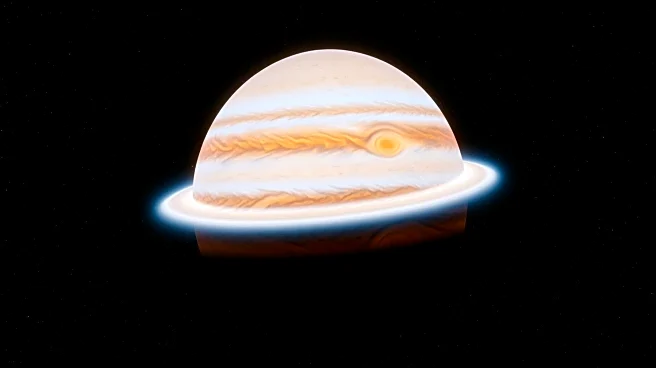
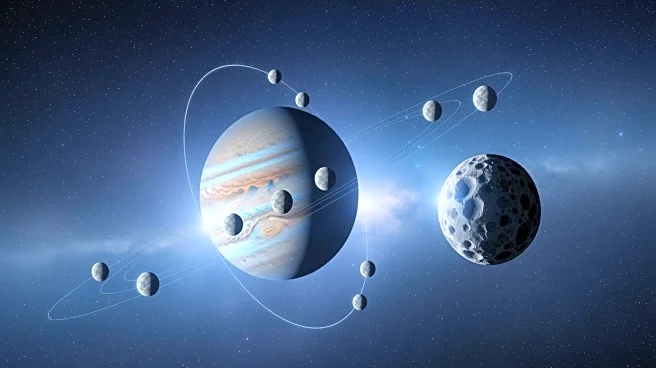
This week, sky watchers in the U.S. can observe a series of celestial events involving Jupiter's moons and the asteroid 44 Nysa. Jupiter, currently positioned in the constellation Gemini, is visible throughout the night. Its Galilean moons, including
Ganymede and Europa, are engaging in transits and occultations. Ganymede will disappear behind Jupiter in an occultation visible across the U.S., while Europa will transit in front of Jupiter, casting its shadow on the planet's surface. Additionally, asteroid 44 Nysa, located in the constellation Cancer, is well-positioned for evening viewing. This ninth-magnitude asteroid is near the border with Gemini and can be observed with a telescope. These events provide a rich opportunity for amateur astronomers to observe dynamic celestial phenomena.
Why It's Important?
These astronomical events offer significant opportunities for both amateur and professional astronomers to study and enjoy the night sky. Observing the transits and occultations of Jupiter's moons can provide insights into the dynamics of the Jovian system. Such events are also educational, offering a practical demonstration of celestial mechanics. The visibility of asteroid 44 Nysa adds another layer of interest, as it allows observers to track an object within our solar system's asteroid belt. These observations can contribute to a broader understanding of asteroid characteristics and movements. For the general public, these events can spark interest in astronomy and science, encouraging educational pursuits and public engagement with space exploration.
What's Next?
As these celestial events unfold, astronomers and enthusiasts will continue to monitor and document the movements of Jupiter's moons and asteroid 44 Nysa. The data collected can be used for further research and analysis, potentially contributing to scientific publications. Public observatories and astronomy clubs may organize viewing events to engage the community and provide educational experiences. Looking ahead, similar astronomical events will continue to occur, offering ongoing opportunities for observation and study. The interest generated by these events may also lead to increased participation in astronomy-related activities and initiatives.