




What's Happening?
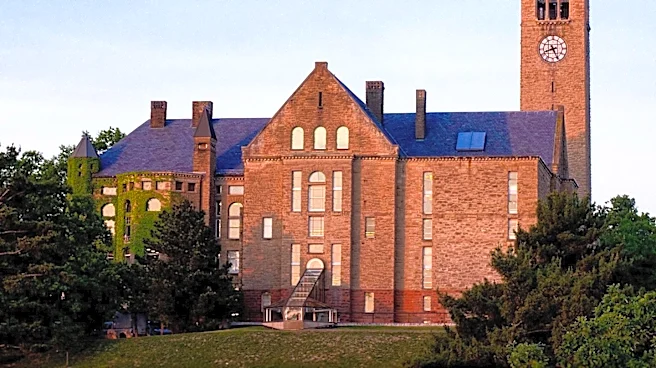
Penn State University has relaunched its former Immersive Experiences Lab (IMEX Lab) as the Immersive Commons, a service department within the Media Commons overseen by Teaching and Learning with Technology (TLT). Located in Rooms 109 and 113 of the Agricultural
Sciences and Industries Building, the Immersive Commons is dedicated to providing students, faculty, and staff with multimedia experiences through immersive technologies such as virtual reality (VR), 360-degree video, 3D scanning, and augmented reality. The relaunch aims to refocus its offerings and align with student and faculty service expectations. Room 113 is now a larger space for room-scale VR experiences and mixed-reality applications, while Room 109 focuses on 3D work, including high-computing power scanning and portable 3D scanners. Dan Getz, a TLT specialist and consultant, facilitates daily operations and workshops, researching and introducing new technology options across Commonwealth Campuses.
Why It's Important?
The expansion of the Immersive Commons at Penn State University signifies a growing institutional commitment to advanced technological education and research. By providing state-of-the-art facilities for VR, AR, and 3D scanning, the university is equipping its community with tools essential for innovation in various fields, from scientific research to creative arts. This initiative can enhance interdisciplinary collaboration and prepare students for careers in rapidly evolving tech sectors. The focus on practical applications and quality experiences, as highlighted by Dan Getz, ensures that the technology serves meaningful educational and research objectives rather than merely being a novelty. This investment positions Penn State as a leader in immersive technology integration within academia, potentially attracting top talent and fostering groundbreaking projects.
What's Next?
The Immersive Commons will host an open house on Thursday, November 17, from 11 a.m. to 2 p.m., inviting visitors to explore four interactive stations. These stations will demonstrate capabilities such as exploring VR environments, creating interactive content with Thinglink, practicing public speaking with AI avatars, and digitizing and scanning in 3D. Following the open house, the space will be available for students, faculty, and staff to book appointments via the Media Commons Appointment Request Form. Walk-ins will also be welcome when staff are present, from 9 a.m. to 5 p.m., Monday through Friday, during class sessions. This structured approach ensures accessibility and continued engagement with the new resources, fostering ongoing innovation and learning within the university community.
Beyond the Headlines
The relaunch of the Immersive Commons reflects a broader trend in higher education to integrate immersive technologies into the learning and research landscape. This move goes beyond mere technological adoption; it represents a shift towards experiential learning and the development of critical skills for a future workforce increasingly reliant on digital and spatial computing. The ethical implications of AI-powered tools, such as those used for public speaking practice, and the responsible use of 3D scanning data, will likely become important considerations for the university. Furthermore, the initiative could foster a culture of digital literacy and innovation, influencing curriculum development and research methodologies across various disciplines, ultimately shaping how knowledge is created and disseminated.