
What's Happening?
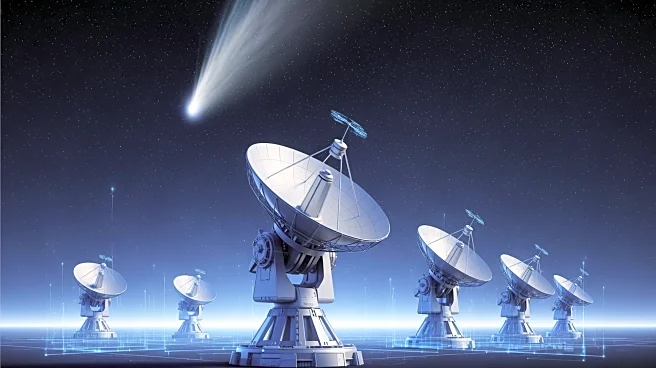
The United Nations' International Asteroid Warning Network (IAWN) is actively monitoring the interstellar comet 3I/ATLAS as it approaches its closest point to Earth on December 19. The comet will pass
within approximately 167 million miles of the planet. This observation is part of a broader effort by IAWN, which includes over 80 observatories and citizen scientists worldwide, to track near-Earth objects. The campaign aims to enhance technical capabilities in astrometry, which involves measuring the positions of celestial bodies. The network, coordinated by NASA, is testing new techniques to improve future tracking and potential spacecraft missions to similar comets. The findings from this campaign are expected to be published in a peer-reviewed journal next year.
Why It's Important?
The monitoring of comet 3I/ATLAS by the IAWN is significant as it represents a collaborative international effort to improve the understanding and tracking of interstellar objects. This initiative not only strengthens global preparedness for potential asteroid threats but also advances scientific knowledge about the behavior and composition of such celestial bodies. The campaign's success could lead to improved methods for predicting and mitigating the risks posed by near-Earth objects, which is crucial for planetary defense. Additionally, the data collected could inform future space missions, potentially aiding in the development of technologies for exploring or redirecting asteroids and comets.
What's Next?
The IAWN will continue its observation campaign until the comet's closest approach and beyond, with plans to analyze and publish the data collected. The network's findings will contribute to ongoing research and may influence future strategies for monitoring and responding to near-Earth objects. As the campaign progresses, further collaboration among international observatories and citizen scientists is expected, fostering a more comprehensive understanding of interstellar comets and their potential impact on Earth.