
What's Happening?
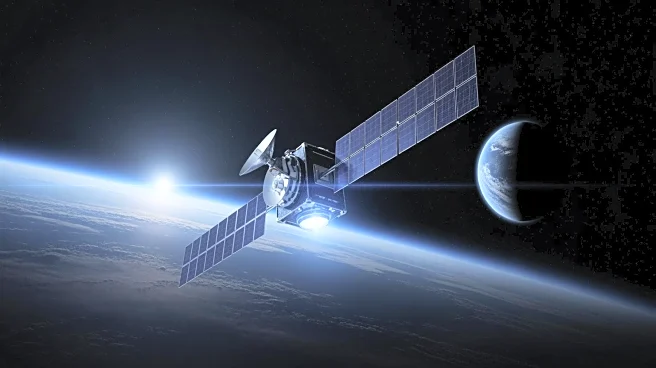
NASA's Pandora small satellite has successfully established communication with mission controllers, confirming its operational status following its launch from Vandenberg Space Force Base in California
on January 11, 2026. The satellite, part of a mission to study exoplanets, was launched aboard a SpaceX Falcon 9 rocket. Pandora's mission is to analyze the atmospheres of exoplanets, which are planets outside our solar system, by observing the light spectrum as these planets transit their host stars. This process helps identify atmospheric components like water vapor and clouds. The mission aims to differentiate between signals from the planets and the noise from their host stars, using a combination of visible and near-infrared data. The mission is managed by NASA's Goddard Space Flight Center, with contributions from various institutions including Lawrence Livermore National Laboratory and Blue Canyon Technologies.
Why It's Important?
The Pandora mission represents a significant advancement in the study of exoplanets, which could enhance our understanding of planetary systems beyond our own. By improving the ability to detect and analyze the atmospheres of these distant worlds, scientists can better assess their potential habitability and the presence of life-supporting conditions. This mission also demonstrates the collaborative efforts of multiple scientific and engineering institutions, showcasing the integration of advanced technology in space exploration. The findings from Pandora could influence future missions and the development of new technologies for space observation.
What's Next?
Pandora will continue its mission by repeatedly observing selected exoplanet systems to gather comprehensive data over time. This will involve monitoring each system for 24-hour periods to capture multiple transits and variations in stellar activity. The data collected will be processed and analyzed by NASA's Ames Research Center and other participating universities. The mission's progress and findings will be shared through NASA's communication channels, contributing to the broader field of exoplanet research and potentially guiding future exploratory missions.