







What's Happening?
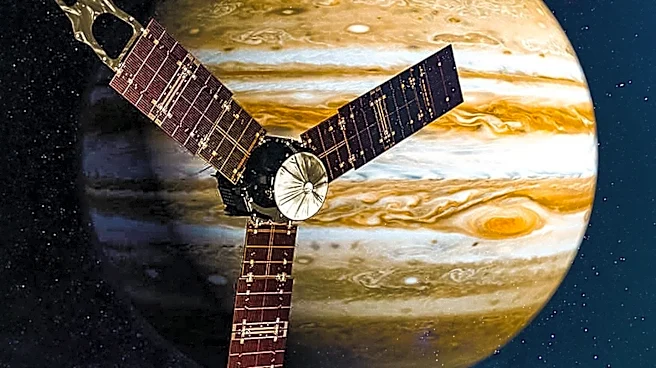
NASA's Juno spacecraft has provided new insights into the subsurface temperatures of Jupiter's moon Io, the most volcanically active body in the solar system. During close flybys in late 2023 and early 2024, Juno used its Microwave Radiometer (MWR) instrument
to measure temperatures beneath Io's surface, revealing heat levels far exceeding those caused by sunlight alone. The data showed localized regions of elevated heat, suggesting that heat is moving from Io's molten interior through its crust. This discovery offers a new method for studying volcanic activity on planetary bodies.
Why It's Important?
The findings from Juno's observations of Io have significant implications for understanding volcanic processes on Earth and other celestial bodies. By revealing how heat moves through Io's crust, scientists can gain insights into the mechanisms driving volcanic activity. This knowledge could improve monitoring and forecasting of volcanic eruptions on Earth. Additionally, understanding tidal heating, which powers Io's volcanism, can inform studies of other moons and planets, potentially aiding in the search for life in subsurface oceans on moons like Europa and Ganymede.