
What's Happening?
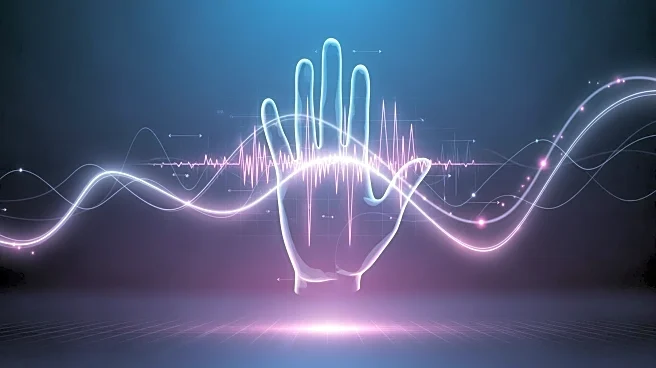
A recent study has investigated the use of in-air signatures for contactless biometric verification, utilizing a fingertip tracking system with a standard camera. Conducted under the ethical permissions
of YTU Ethical Committee, the study involved 25 participants who provided signature data. The research employed a Siamese Neural Network architecture to differentiate between pairs of signature samples by comparing their similarity. The data collection process involved participants signing within a fixed area in front of a laptop camera, with a custom Python application capturing the signature trajectory. The study aimed to enhance the accuracy and reliability of biometric verification systems by using a combination of data collection, validation strategy, and model design.
Why It's Important?
The development of contactless biometric verification systems is significant as it offers a non-intrusive and hygienic alternative to traditional methods, which often require physical contact. This technology could have wide-ranging applications in security and identity verification, particularly in environments where hygiene is a concern, such as healthcare facilities. By improving the accuracy of biometric systems, this research could enhance security measures in various sectors, reducing the risk of identity fraud. The use of advanced neural network architectures like the Siamese Neural Network also highlights the potential for machine learning to improve the robustness and reliability of biometric systems.
What's Next?
Future developments in this field may focus on refining the technology to improve its accuracy and applicability across different environments and populations. Researchers might explore integrating this system with other biometric modalities to create multi-factor authentication systems. Additionally, there could be efforts to commercialize this technology for use in industries such as banking, travel, and healthcare, where secure and efficient identity verification is crucial. Stakeholders, including technology companies and regulatory bodies, may need to address privacy concerns and establish standards for the ethical use of biometric data.
Beyond the Headlines
The adoption of contactless biometric verification systems could lead to broader discussions about privacy and data security. As these systems become more prevalent, there will be a need to ensure that personal data is protected and that users are informed about how their data is used. The ethical implications of biometric data collection and storage will likely become a focal point for policymakers and privacy advocates. Additionally, the technology's impact on employment in sectors reliant on traditional verification methods could be significant, necessitating workforce adaptation and retraining.