



What's Happening?
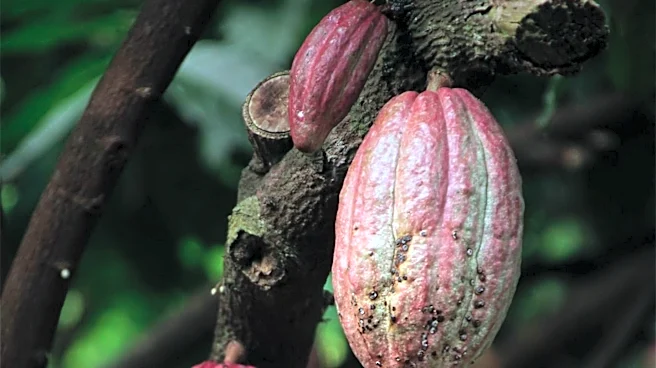
A recent study conducted by scientists from CIRAD and Félix Houphouët-Boigny University in southern Ivory Coast estimates that at least 1.05 billion young wild trees are growing within the country's cocoa farms. Field inventories identified 272 species
among these trees, which primarily originated from seeds dispersed by animals and wind. This discovery highlights a previously underrecognized natural resource that could play a significant role in restoring Ivory Coast's forest cover. The country has experienced substantial deforestation, with its forest cover shrinking from approximately 16 million hectares in the early 20th century to less than 3 million hectares today, largely due to agricultural expansion. The study suggests that existing reforestation programs, which typically involve nursery-grown plants, could be supplemented by leveraging this natural regeneration within cocoa plantings.
Why It's Important?
This finding is crucial for global environmental conservation efforts and sustainable agricultural practices, particularly in regions facing significant deforestation. For the U.S., which is a major consumer of cocoa, the sustainability of cocoa production in countries like Ivory Coast has ethical and supply chain implications. The presence of over a billion wild trees within cocoa farms offers a cost-effective and natural approach to forest restoration, potentially reducing the need for extensive and expensive planting initiatives. This could lead to more resilient ecosystems, improved biodiversity, and enhanced carbon sequestration, contributing to global climate change mitigation efforts. Furthermore, integrating natural regeneration into agricultural landscapes could set a precedent for other commodity-producing nations, influencing international standards for sustainable sourcing and corporate social responsibility among U.S. businesses.
What's Next?
The study's findings align with Ivory Coast's policy for forest preservation, rehabilitation, and extension (PPREF, 2018) and its implementation strategy (SPREF 2019-2030), which aim to increase national forest cover to at least 20%. The SPREF prioritizes agroforestry in agricultural production systems and plans for forest reconstitution through reforestation and exclosure. Assisted natural regeneration, which involves identifying, protecting, and supporting young wild trees, is presented as an economical additional method to achieve these goals within cocoa plantings. Future efforts will likely focus on integrating these natural regeneration strategies into existing and new cocoa farm management practices. This includes encouraging producers to preserve adult trees, which the study found leads to more abundant and diverse natural regeneration, and developing guidelines for managing this wild regrowth.
Beyond the Headlines
The discovery of extensive natural tree regeneration within Ivory Coast's cocoa farms challenges conventional views of agricultural landscapes as ecological dead ends. It underscores the potential for agro-ecosystems to contribute significantly to biodiversity and forest restoration, moving beyond a simple dichotomy of agriculture versus conservation. This approach could foster a more holistic understanding of land use, where agricultural productivity and ecological health are not mutually exclusive but rather interdependent. The ethical implications extend to how international cocoa buyers and consumers perceive their role in supporting sustainable practices. It highlights the importance of incentivizing farmers to adopt agroforestry techniques and protect existing natural regeneration, potentially leading to a more equitable and environmentally sound cocoa supply chain. This paradigm shift could influence global agricultural policies and conservation strategies, promoting integrated landscape management.