
What's Happening?
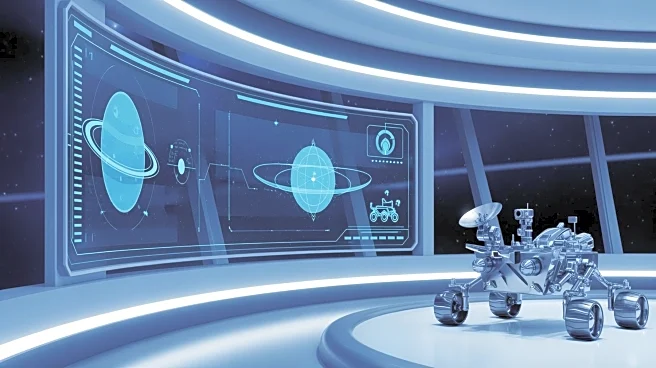
NASA's Jet Propulsion Laboratory (JPL) has inaugurated a new Rover Operations Center (ROC) aimed at advancing mission operations and supporting the development of space technology, particularly in collaboration
with commercial space and artificial intelligence organizations. The ROC is designed to consolidate JPL's expertise in planetary surface missions and expand the use of autonomous systems in upcoming lunar and Mars programs. The facility will serve as a centralized hub for engineering support, mission planning, training, anomaly response, and integration activities for rover and aerial systems. During the inauguration, representatives from commercial space and AI companies participated in technical discussions and demonstrations, highlighting the center's role in increasing mission efficiency and broadening access to JPL's operational capabilities.
Why It's Important?
The establishment of the ROC is significant as it represents a strategic move to enhance the efficiency and capability of NASA's lunar and Mars missions. By integrating advanced autonomy and AI into mission operations, JPL aims to accelerate the development and deployment of new technologies that can improve the performance and longevity of space missions. This initiative not only strengthens NASA's position in space exploration but also fosters collaboration with commercial and AI sectors, potentially leading to innovative solutions and technologies. The ROC's focus on technology transfer and collaborative development could result in significant advancements in digital engineering models and mission-adapted AI tools, benefiting both NASA and its industry partners.
What's Next?
The ROC is expected to play a crucial role in future Moon and Mars missions by providing a platform for testing and implementing new technologies. As JPL continues to develop and refine its autonomous systems, the center will likely facilitate further collaborations with commercial and AI organizations, driving innovation in space exploration. The ongoing application of AI in operational workflows, such as the recent use of generative AI by the Perseverance team, suggests that the ROC will be instrumental in exploring new possibilities for mission planning and execution. The center's efforts to export knowledge and tools through partnerships could lead to a new generation of more efficient and capable space missions.
Beyond the Headlines
The ROC's focus on autonomy and AI integration highlights a broader trend in space exploration towards increased automation and efficiency. This shift could have long-term implications for the industry, potentially reducing the cost and complexity of space missions while increasing their success rates. The collaboration between NASA and commercial space and AI companies may also drive technological advancements that extend beyond space exploration, influencing sectors such as robotics, AI, and digital engineering. As the ROC continues to develop and implement new technologies, it may set a precedent for future research and development centers, emphasizing the importance of collaboration and innovation in advancing scientific and technological frontiers.