





What's Happening?
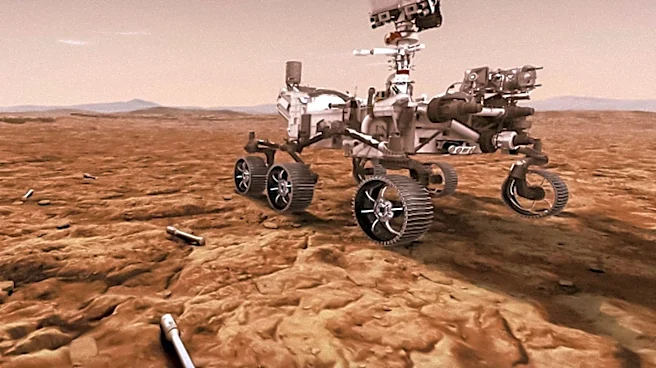
NASA is launching a new initiative called the Perseverance Sample Retrieval Architecture (PSRA) to re-evaluate and establish a fresh strategy for bringing Martian samples back to Earth. This move signifies a renewed focus on the long-standing goal of
robotically collecting and returning specimens from the Red Planet. The PSRA aims to develop impartial recommendations for retrieving the samples that have been collected by the Perseverance rover. This strategic re-evaluation is crucial for optimizing the complex engineering and scientific challenges associated with such a mission, ensuring the most effective and efficient pathway for bringing these invaluable Martian materials to terrestrial laboratories for in-depth study. The initiative underscores NASA's commitment to advancing planetary science and understanding the potential for past or present life on Mars.
Why It's Important?
The Mars Sample Return (MSR) mission is considered a 'Holy Grail' for planetary scientists, as it promises to provide unprecedented insights into the geological history, climate, and potential for life on Mars. Bringing samples back to Earth allows for analysis with advanced laboratory equipment far more sophisticated than what can be deployed on a rover. This could revolutionize our understanding of Mars and potentially answer fundamental questions about the origins of life. For the U.S., leading this mission reinforces its position in space exploration and scientific discovery, driving innovation in robotics, spacecraft design, and astrobiology. The success of MSR could also inspire future generations in STEM fields and foster international collaboration in space science.
What's Next?
The PSRA initiative will focus on developing a comprehensive set of recommendations for the Mars Sample Return mission. This will likely involve detailed studies of various mission architectures, technological requirements, and operational strategies. NASA will need to assess the feasibility and risks associated with different approaches to sample retrieval and transport. The recommendations will then inform the subsequent phases of mission planning and development, potentially leading to adjustments in the overall MSR strategy. This process will involve extensive collaboration with scientific and engineering communities to ensure that the chosen approach is robust, scientifically sound, and achievable within budgetary and technological constraints. The ultimate goal is to refine the plan for safely and effectively returning Martian samples to Earth.
Beyond the Headlines
Beyond the immediate scientific gains, a successful Mars Sample Return mission carries profound implications. The analysis of Martian samples could reveal whether life ever existed on Mars, fundamentally altering humanity's perception of its place in the universe. It also presents significant ethical considerations regarding planetary protection and the potential for introducing extraterrestrial microorganisms to Earth, or vice versa. The mission pushes the boundaries of engineering and robotics, fostering innovations that could have applications in other extreme environments or even in terrestrial industries. The long-term impact could include a deeper understanding of planetary evolution, the conditions necessary for life, and the potential for future human exploration and settlement of Mars.