







What's Happening?
During World War II, over 120,000 people of Japanese ancestry, two-thirds of whom were U.S. citizens, were forcibly removed from their homes and confined in ten government-run camps across the United States. This action followed President Franklin D.
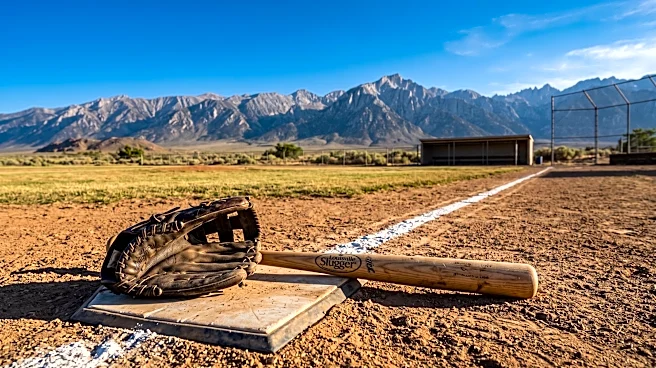
Roosevelt's Executive Order 9066, issued on February 19, 1942, shortly after the attack on Pearl Harbor. The order granted the secretary of war the power to exclude individuals from military areas, which was then applied to Japanese Americans on the West Coast. One such facility was the Manzanar War Relocation Center in California. Despite being surrounded by barbed wire and guard towers and feeling betrayed by their government, these incarcerated individuals maintained American traditions, including celebrating Thanksgiving and the Fourth of July. Within a month of their arrival at Manzanar, they constructed a baseball diamond, and the camp eventually fielded over 100 baseball and softball teams. Baseball remained a vital part of life at Manzanar until the camp's closure in 1945.
Why It's Important?
The story of baseball at Manzanar highlights the resilience and determination of Japanese Americans who, despite unjust incarceration, preserved aspects of their cultural identity and American traditions. The use of terms like 'evacuation' and 'relocation' during the war obscured the reality of racially targeted mass confinement, making accurate terminology crucial for historical clarity and honoring the experiences of those affected. This historical account, as detailed in 'Baseball at Manzanar: How We Played the Game, 1942-1945,' underscores the unifying power of baseball, even in the most challenging circumstances. It serves as a reminder of a period in U.S. history where civil liberties were suspended based on ethnicity, and the importance of recognizing and learning from past injustices. The continued efforts to restore the baseball field at the Manzanar National Historic Site and the planned events in 2024 and 2026 further emphasize the ongoing significance of this history.
What's Next?
The Manzanar National Historic Site is undergoing a reconstruction and reclamation of its baseball field. This effort is expected to culminate in a historic doubleheader played there in 2024, followed by a Grand Opening event for the ballfield in 2026. These events will serve as significant milestones in commemorating the experiences of Japanese Americans incarcerated during World War II and celebrating their enduring spirit. The Society for American Baseball Research (SABR) is actively involved in telling this story through its digital library book and companion website, featuring essays, rare photos, and interviews with survivors and their families. These initiatives aim to ensure that the history of baseball at Manzanar and the broader context of Japanese American incarceration are preserved and understood by future generations.
Beyond the Headlines
The narrative of baseball at Manzanar extends beyond a simple sports story; it delves into profound ethical and societal implications. The forced removal and incarceration of Japanese Americans during World War II represent a significant breach of civil liberties and a stark example of racial discrimination in U.S. history. The euphemistic language used at the time, such as 'war relocation centers,' obscured the reality of unjust imprisonment, underscoring the critical importance of precise and honest historical terminology. The act of playing baseball within the confines of Manzanar symbolizes a form of resistance and a commitment to maintaining normalcy and hope amidst adversity. It highlights the human capacity for resilience and the role of cultural practices in preserving identity and community during times of extreme hardship. This historical episode continues to inform discussions about civil rights, government power, and the protection of minority groups in the United States.