






What's Happening?
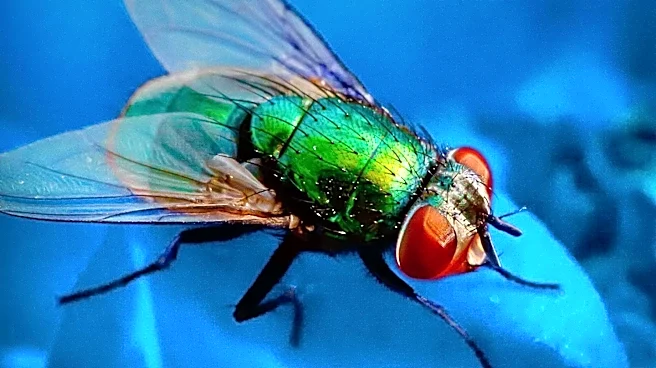
Software engineer Alex Wormuth has successfully programmed a simulated fruit fly brain to play the 1993 first-person shooter game, Doom. This development follows Google's recent release of a comprehensive map of a male fruit fly's brain and central nervous
system, which contains 11,700 types of neurons and 166,000 neurons. Wormuth utilized this detailed neural map to create a simulated brain that processes game inputs. Each frame of Doom generates 3,335 brightness inputs and 811 R8 color inputs, which are fed into the simulated brain's 25.6 million connections. The brain then uses this information to determine the fly's next move, including responding to damage by targeting PPL101 dopamine receptors, which control hunger and aggression in real fruit flies. The progress of this simulated fly brain can be observed on Wormuth's Doomfly website, which displays sensory input, neural activity, and real-time gameplay.
Why It's Important?
This experiment represents a significant step in understanding brain function and the potential applications of detailed neural mapping. By demonstrating that a simulated brain can learn and react within a complex environment like a video game, researchers can gain insights into how biological brains process information and make decisions. The ability to map and simulate such intricate neural networks could accelerate advancements in neuroscience, artificial intelligence, and robotics. It provides a tangible, observable model for studying neural pathways and their responses to external stimuli. Furthermore, the project highlights the growing trend of interdisciplinary collaboration between neuroscience and computer science, pushing the boundaries of what is possible in both fields. The success of this project could inspire further research into simulating more complex brains and their interactions with various digital and physical environments.
What's Next?
Following the success with Doom, other developers are already expanding the capabilities of simulated fly brains. Jessica Paquette has set up a similar neural network to play Super Mario 64, while Lyra Bubbles has taught one to play Beat Saber. Additionally, X users David and Shashank Jain have taught the fly brain to navigate an escape room and play soccer, respectively. Alex Wormuth further experimented by giving the fly brain $100 worth of Bitcoin to trade, and X user Simba enabled it to deploy its own cryptocurrency token on Robinhood. These ongoing experiments suggest a rapid expansion of tasks that simulated fly brains can perform, ranging from gaming to financial trading and even cryptocurrency deployment. In the long term, these experiments are expected to have a substantial impact on neuroscience, potentially leading to a deeper understanding of brain mechanisms and more sophisticated AI development.
Beyond the Headlines
The ability to simulate a fruit fly's brain and have it interact with complex digital environments like video games opens up profound ethical and philosophical questions. As simulations become more sophisticated, the line between biological and artificial intelligence blurs, prompting discussions about consciousness, autonomy, and the nature of intelligence itself. This development could also lead to new approaches in understanding and treating neurological disorders by allowing researchers to model and test interventions in a controlled, simulated environment. On a broader societal level, the rapid advancement in neural simulation could influence future AI development, potentially leading to more biologically inspired AI systems that mimic the efficiency and adaptability of natural brains. The project also underscores the increasing accessibility of advanced scientific data, as Google's brain map was publicly available, enabling independent developers like Wormuth to conduct groundbreaking research.