






What's Happening?
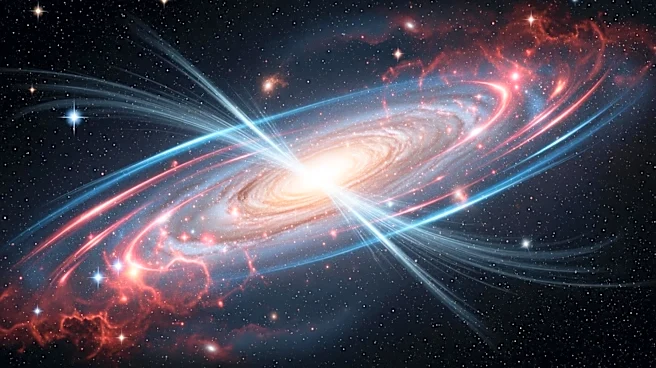
The Hubble Space Telescope, along with other space observatories like the James Webb Space Telescope, Chandra, and Spitzer, has been instrumental in studying the Cigar Galaxy (M82). This galaxy, located about 12 million light-years away, is known for
its intense star formation activity, earning it the classification of a 'starburst galaxy.' Recent observations have revealed that the galaxy's center expels gas at speeds of up to 2 million miles per hour, enough to form seven suns each year. These winds are driven by superheated gas and cosmic rays, which create pressure that pushes the gas outward. The XRISM spacecraft has measured these winds, providing new insights into the dynamics of starburst galaxies.
Why It's Important?
The findings from the Hubble and other telescopes are significant for understanding the processes that govern star formation in galaxies. The ability to measure the speed and composition of galactic winds helps astronomers test and refine models of how galaxies evolve. The discovery that M82 expels more gas than previously thought challenges existing theories and suggests that there may be unknown mechanisms at play. This research could lead to a better understanding of the lifecycle of galaxies and the role of cosmic rays in shaping them. The implications extend to broader astrophysical theories and could influence future space exploration and observation strategies.
What's Next?
Further observations by the XRISM spacecraft and other telescopes are planned to continue studying the Cigar Galaxy. These efforts aim to resolve the mystery of the missing solar masses and refine models of starburst galaxies. The ongoing research will help scientists understand whether the expelled gas escapes the galaxy or contributes to other processes. This could lead to new discoveries about the formation and evolution of galaxies, potentially impacting our understanding of the universe's structure and the forces that shape it.