






What's Happening?
While China's climate emissions have plateaued or are falling due to consistent investment in renewable energy and electric vehicles, the U.S. trajectory is different. U.S. greenhouse gas emissions rose in 2025, making it the only major economy with a significant
increase last year, according to a United Nations report. Although U.S. emissions are projected to fall slightly this year with less coal burning, experts like Alex Wang of UCLA Law argue that the U.S. could achieve greater reductions with more consistent, long-term policy support for climate technologies. The Biden administration introduced financial incentives for renewables and EVs, but the Trump administration has reversed these policies, creating regulatory hurdles for solar and wind, canceling tax breaks, and proposing cuts to methane regulations, prioritizing an 'energy dominance agenda' that supports coal plants. This policy 'whiplash' is cited as a major impediment to scaling up climate tech industries in the U.S.
Why It's Important?
The divergence in emissions trends between the U.S. and China highlights the critical role of consistent long-term policy in driving decarbonization. China's sustained investment over two decades has made it a global leader in producing and deploying clean energy technologies, directly contributing to its emissions reductions. In contrast, the U.S.'s flip-flopping policies create uncertainty for investors and hinder the scaling of domestic climate tech industries. This instability not only slows down emissions reductions but also puts the U.S. at a competitive disadvantage in the global clean energy market. The increasing energy demand from data centers in the U.S., largely powered by fossil fuels, further exacerbates the emissions challenge, making consistent clean energy deployment even more crucial. The lack of a stable policy environment undermines efforts to meet climate goals and secure a leading position in the green economy.
What's Next?
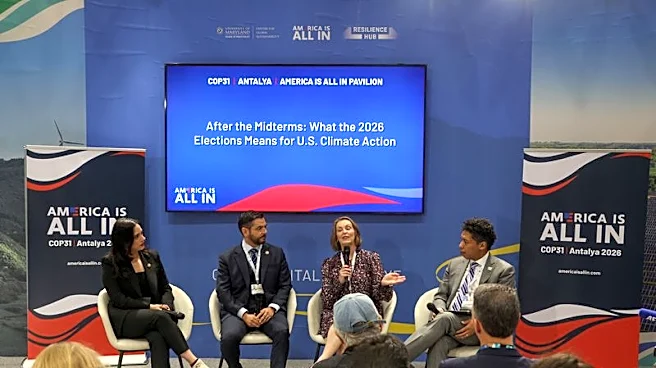
The future of U.S. climate emissions and clean energy deployment remains highly dependent on political leadership and policy consistency. Without a stable, long-term framework, the U.S. may continue to struggle in scaling up its climate tech industries and achieving significant emissions reductions. The ongoing debate between prioritizing fossil fuel production and accelerating the clean energy transition will shape the country's energy landscape. International climate talks, such as COP31, will likely continue to pressure the U.S. to strengthen its commitments and policies. The growth of energy-intensive sectors like data centers will necessitate innovative solutions to power them with clean energy, requiring significant investment and policy support to match deployment with demand. The U.S. will need to address its policy 'whiplash' to effectively compete with nations like China in the global clean energy transition.
Beyond the Headlines
The U.S.'s inconsistent approach to climate policy has broader implications for its global leadership and economic competitiveness. While China has strategically built nationwide supply chains for clean energy technologies, the U.S. risks falling behind in a rapidly evolving global market. This 'policy whiplash' not only affects environmental outcomes but also impacts job creation, technological innovation, and national security. The reliance on fossil fuels for new energy demands, particularly from data centers, underscores a systemic challenge in transitioning away from carbon-intensive sources. Ethically, the U.S.'s fluctuating commitment to climate action raises questions about its responsibility as a major historical emitter. Culturally, it reflects deep political divisions that hinder consensus-building on critical long-term issues, making it difficult to implement the sustained efforts needed for a comprehensive energy transition.