







What's Happening?
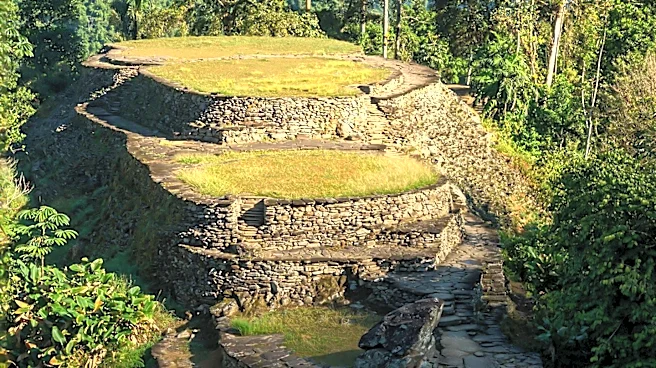
Archaeologists have uncovered hundreds of vast earthworks in the Amazon rainforest, which they say are evidence of a 'lost civilization' that flourished nearly 2,000 years ago. Researchers believe the geometrically patterned structures, known as geoglyphs,
were built by an advanced pre-colonial society, known as the Aquiry, between 600BC and AD850. The scientists used cutting-edge airborne laser scanning technology to find hundreds of previously unknown earthworks, suggesting that at its peak, the civilization may have numbered 1.25 to 3 million people.
Why It's Important?
This discovery challenges previous assumptions about the Amazon rainforest being a 'virgin wilderness' occupied only by small groups of hunter-gatherers. The presence of these geoglyphs indicates that the region was home to a complex, organized society with sophisticated planning and labor. This revelation could lead to a reevaluation of pre-colonial civilizations and urban development in the Amazon, offering new insights into how ancient societies interacted with their environment and managed resources sustainably.