
What's Happening?
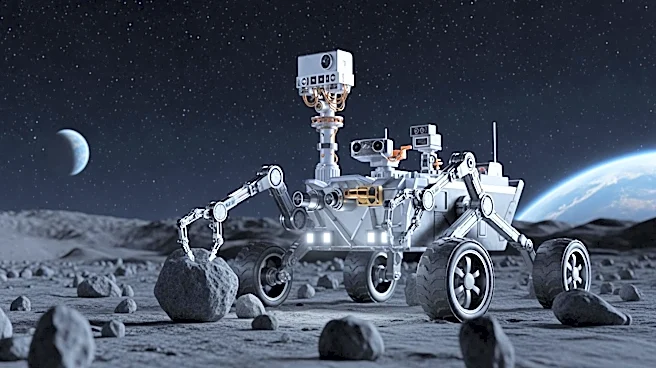
NASA has awarded a $6.9 million contract to Interlune, a Seattle-based company, to develop technologies for extracting resources from the Moon's surface. This initiative, part of NASA's Small Business
Innovation Research (SBIR) program, aims to advance in-situ resource utilization (ISRU) technologies. These technologies will enable the extraction of hydrogen, helium-3, and other resources from lunar regolith, supporting long-duration missions to the Moon and Mars. Interlune will design and test engineering units and flight hardware to collect and analyze lunar soil, using a mass spectrometer inspired by NASA's MSOLO technology. This effort builds on previous work with NASA's Flight Opportunities program, which tested payload prototypes in lunar gravity conditions.
Why It's Important?
The development of ISRU technologies is crucial for reducing the cost and complexity of future space missions. By enabling the use of lunar resources, NASA aims to establish a sustainable human presence on the Moon, which is a key objective of the Artemis program. This initiative not only supports NASA's exploration goals but also fosters commercial partnerships, allowing private companies to leverage proven NASA technologies. The success of this project could lead to significant advancements in space exploration, providing new opportunities for scientific research and commercial ventures in space.
What's Next?
Interlune will proceed with the design, construction, and testing of the resource-prospecting tools over the next year and a half. The company will focus on validating these technologies to ensure they are ready for integration into future lunar missions. NASA's SBIR program will continue to support small businesses in developing innovative technologies, with the next round of proposals closing on May 21, 2026. As these technologies mature, they are expected to play a critical role in upcoming lunar missions, potentially influencing the strategies of other space agencies and commercial entities involved in lunar exploration.