




What's Happening?
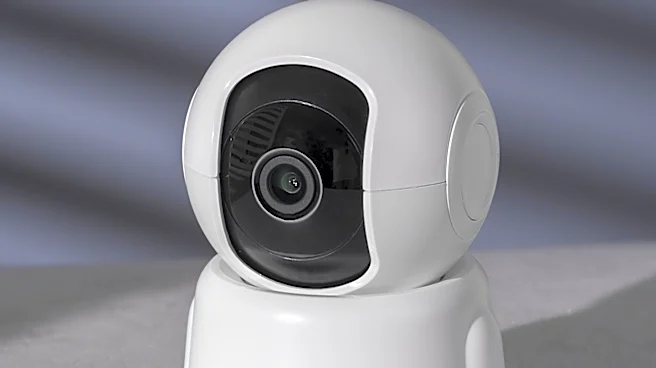
Researchers at Sandia National Laboratories in Albuquerque, New Mexico, are utilizing an indoor test facility to create controlled heavy rain and thick fog conditions. This initiative aims to study the performance of commercial security cameras and sensor
networks under adverse weather. The facility allows for repeatable testing environments, enabling scientists to measure how reliably these systems detect people and objects as visibility decreases. The team, led by optical engineer Christian Pattyn and computer engineer Maria Primavera, is using commercially available cameras to collect benchmark data. The chamber's capabilities have recently expanded to include heavy rain, in addition to its existing fog generation system, allowing for a broader range of low-visibility testing.
Why It's Important?
The ability to test security cameras and sensors in controlled, repeatable weather conditions is crucial for national security and various commercial applications. Many critical infrastructure sites and facilities rely on these systems for surveillance and threat detection. Understanding their limitations in fog and heavy rain can lead to the development of more robust and reliable security technologies. This research will help identify which sensing approaches remain effective in degraded visual environments and where current systems fall short. The data collected will also be vital for training machine learning algorithms, potentially improving automated detection systems that can interpret images even when human visibility is compromised, thereby enhancing overall security capabilities.
What's Next?
The research team will analyze the synchronized camera data to determine how performance varies across different fog and rain conditions. This data will be used to create a labeled dataset for testing and training machine learning algorithms, aiming to improve automated detection systems. The findings will help researchers understand the capabilities and limitations of current camera systems in low-visibility scenarios. Future steps may involve further refinement of the testing methodologies and the development of new sensor technologies that can overcome the challenges posed by adverse weather. The insights gained could lead to advancements in security systems for national defense, critical infrastructure, and public safety.
Beyond the Headlines
This research has broader implications beyond immediate security applications. The ability to simulate and study extreme weather conditions in a controlled environment could benefit various fields, including autonomous vehicle development, aviation safety, and climate modeling. Understanding how sensors perform in challenging conditions is essential for the safe and effective deployment of technologies that rely on visual data. Furthermore, the project highlights the interdisciplinary nature of modern scientific research, combining optical engineering, computer science, and environmental simulation. The ethical considerations of advanced surveillance technologies, particularly their accuracy and potential for bias in diverse conditions, also come into play as these systems become more sophisticated.