
What's Happening?
Researchers Cong Liu and Ronald Cohen from the Carnegie Institution have conducted computer simulations suggesting the existence of a previously unknown state of matter deep within the icy giant planets
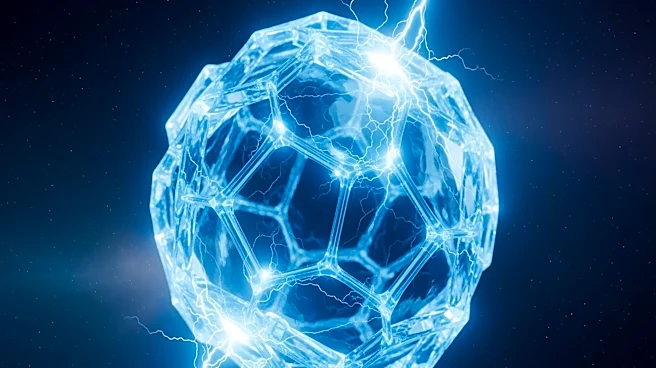
Neptune and Uranus. This state, termed a quasi-one-dimensional superionic state of carbon hydride, is believed to occur under extreme pressure and temperature conditions. The simulations indicate that hydrogen atoms move along spiral trajectories within an ordered hexagonal structure, creating a superionic state where one type of atom remains in the crystal structure while the other becomes mobile. This discovery is significant as it may influence the understanding of heat and electricity distribution within these planets, potentially affecting theories on magnetic field formation.
Why It's Important?
The discovery of a superionic state in Neptune and Uranus could have profound implications for planetary science and materials science. Understanding the internal dynamics of these planets can provide insights into the formation of magnetic fields and energy redistribution in their inner layers. This knowledge is crucial for comprehending planetary dynamics and the potential for life-supporting conditions in distant parts of the universe. Additionally, the ability to observe directional phenomena in condensed matter could advance materials science, offering new possibilities for engineering applications. The findings suggest that even simple compounds can transition into complex phases under extreme conditions, expanding the scope of materials research.