






What's Happening?
Astronomers have utilized the James Webb Space Telescope (JWST) to study the surface composition of the rocky exoplanet LHS 3844 b. Led by researchers from the Max Planck Institute for Astronomy and the Center for Astrophysics at Harvard & Smithsonian,
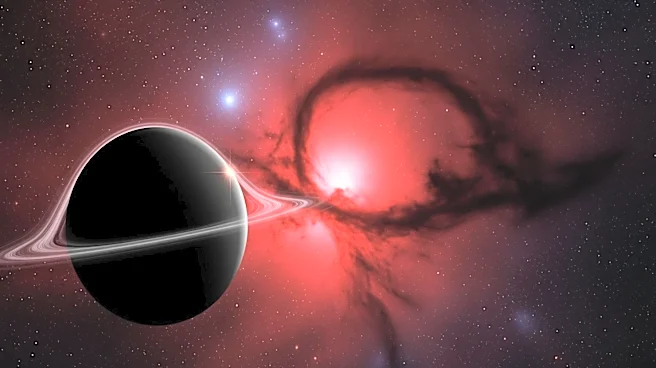
the study reveals that LHS 3844 b is a dark, airless planet with a basalt-like surface. The planet, which is 30% larger than Earth, orbits a cool red dwarf star and is tidally locked, meaning one side constantly faces the star. This results in a hot dayside with temperatures around 1000 Kelvin. The research, published in Nature Astronomy, suggests that the planet's surface resembles that of the Moon or Mercury, lacking an Earth-like silicate crust. This indicates that Earth-like plate tectonics and significant water presence are unlikely on LHS 3844 b.
Why It's Important?
The findings from this study are significant as they enhance our understanding of exoplanetary geology, a field that draws on Earth-based geological knowledge. By analyzing the surface composition of LHS 3844 b, scientists can infer the planet's geological history and activity. The absence of an Earth-like crust suggests limited tectonic activity and water, which are crucial for life as we know it. This research contributes to the broader quest of understanding the diversity of planetary systems and the potential for life beyond Earth. The study also demonstrates the capabilities of the JWST in providing detailed observations of distant exoplanets, paving the way for future explorations of other rocky planets.
What's Next?
The research team plans to conduct further observations using the JWST to clarify the nature of LHS 3844 b's surface. By analyzing how solid slabs and powders emit or reflect light, they aim to determine the surface roughness and geological activity of the planet. This approach, similar to techniques used for characterizing asteroids, could provide more insights into the planet's crust and help resolve ambiguities about its geological state. These efforts will not only enhance our understanding of LHS 3844 b but also aid in the study of other rocky exoplanets, potentially identifying those with conditions suitable for life.
Beyond the Headlines
The study of LHS 3844 b highlights the challenges and opportunities in exoplanetary research. The ability to detect and analyze the surface composition of distant planets opens new avenues for understanding planetary formation and evolution. The findings also raise questions about the prevalence of Earth-like conditions in the universe and the factors that contribute to a planet's habitability. As technology advances, astronomers will continue to explore these questions, potentially leading to groundbreaking discoveries about our place in the cosmos.