
What's Happening?
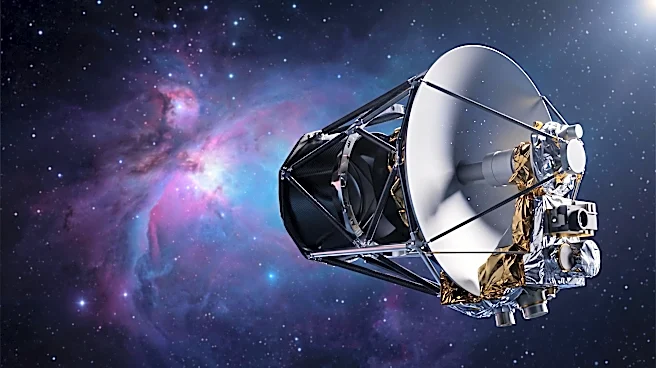
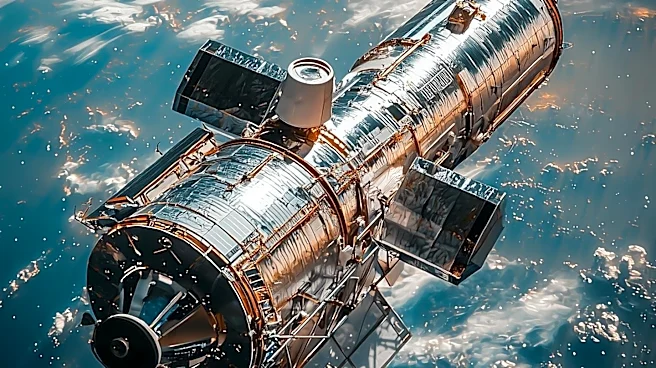
NASA's Hubble Space Telescope has successfully completed 200,000 orbits around Earth, marking a significant milestone over 36 years since its launch in April 1990. Despite being designed for a 15-year
operational lifespan, Hubble has traveled more than 5 billion miles and conducted over 1.7 million observations of the universe. This latest achievement occurred while the telescope was engaged in studying a cosmic mystery related to the expansion rate of the universe. Specifically, Hubble is observing the galaxy cluster MACS J0417 to monitor the reappearance of a gravitationally lensed supernova named Athena. This ongoing observation is crucial for refining measurements of the universe's expansion rate, a key scientific legacy of the Hubble mission. The telescope orbits Earth approximately 15 times daily, at an altitude of about 300 miles and a speed of 17,000 mph, providing unparalleled views of the cosmos by operating above atmospheric distortion.
Why It's Important?
The Hubble Space Telescope's continued operation and its 200,000-orbit milestone are vital for advancing astronomical research and our understanding of the universe. Its ability to observe in ultraviolet, visible, and near-infrared light, unhindered by Earth's atmosphere, provides unique data that complements newer telescopes like the James Webb Space Telescope. The current mission to track supernova Athena through gravitational lensing is particularly significant for addressing the 'Hubble Tension' – the discrepancy between different measurements of the universe's expansion rate. By precisely timing the reappearance of Athena, astronomers can improve mass maps of galaxy clusters and refine the Hubble Constant, which dictates the universe's future. This ongoing data collection helps scientists explore fundamental questions about dark matter, dark energy, and the evolution of the cosmos, impacting theoretical physics and cosmology.
What's Next?
The Hubble Space Telescope is expected to remain scientifically productive into the next decade, with NASA planning for a controlled disposal in the mid-2030s as atmospheric drag gradually lowers its orbit. In the immediate future, Hubble will continue its observations of the galaxy cluster MACS J0417, awaiting the reappearance of supernova Athena. The timing of these reappearances will provide critical data to refine the universe's expansion rate and potentially uncover new physics if discrepancies arise. Meanwhile, the Nancy Grace Roman Space Telescope, recently launched, is poised to build upon Hubble's legacy, offering a wider field of view and faster survey capabilities. Roman's data, which will be publicly available, is expected to generate an unprecedented volume of information, allowing astronomers and even students to explore new patterns and unusual objects in the universe, further expanding our cosmic understanding.
Beyond the Headlines
Hubble's enduring success, far beyond its initial design life, highlights the long-term value of foundational scientific infrastructure and sustained investment in space exploration. Its continued contributions, even with only one working gyroscope, underscore the ingenuity and dedication of the teams managing these complex missions. The 'Hubble Tension' itself represents a profound challenge in astrophysics, suggesting that our current cosmological models might be incomplete. The data from Hubble's observations of supernova Athena could either validate existing models or necessitate a re-evaluation of fundamental physical laws. This pursuit of knowledge not only expands scientific understanding but also inspires public interest in science and astronomy, fostering a deeper appreciation for the universe and humanity's place within it. The legacy of Hubble will continue to influence future generations of scientists and space missions.