



What's Happening?
The German Institute for International and Security Affairs (SWP) recently participated in a conference focused on European security cooperation. This event, titled 'British, German and French Progressive Trialogue on Security and Defence in Europe,'
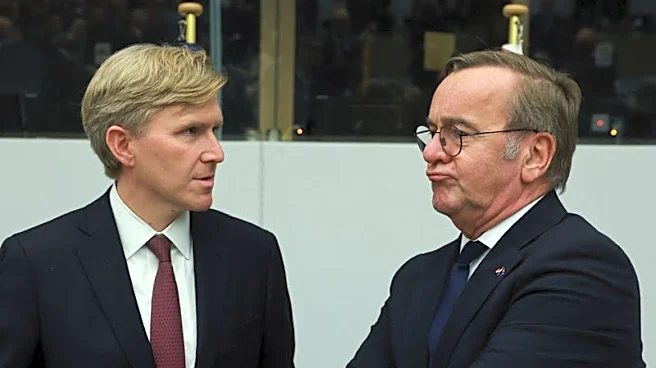
was held on November 16, 2026, and co-organized by the Royal United Services Institute (RUSI), the Friedrich-Ebert-Stiftung (FES) London office, and the Institut de Relations Internationales et Stratégiques (IRIS), Paris. The conference brought together centre-left parliamentarians, ministers, policy experts, and academics from the UK, France, and Germany to discuss the growing role of the E3 group in continental security. Experts from various institutions, including SWP, King's College London, ETH Zurich, and the Centre for European Reform, contributed to the discussions. The primary focus was on how these nations and their respective parties view developments in European security and the crucial role they play in ensuring any future Ukrainian peace deal is sustainable.
Why It's Important?
The participation of the German Institute for International and Security Affairs (SWP) in these high-level discussions underscores the importance of collaborative research and policy formulation in addressing complex security challenges in Europe. The E3 format (UK, France, and Germany) is highlighted as essential for ensuring a unified position on security issues, drawing parallels to its past role in negotiations concerning Iran's nuclear program. This collaboration is deemed critical for defining a new European security architecture, especially in the context of the ongoing conflict in Ukraine. For the U.S., a stable and secure Europe, with strong internal cooperation among its key players, directly impacts transatlantic security alliances and shared strategic interests. The discussions aim to anchor security cooperation beyond governmental levels, involving parliaments and civil society organizations, which could lead to more robust and broadly supported security policies.
What's Next?
The discussions held at the conference are expected to inform future policy directions and enhance cooperation among the UK, France, and Germany on security and defense matters. The emphasis on overcoming excessive industrial competition suggests a move towards more integrated defense capabilities and procurement within Europe. This could lead to more coordinated responses to security threats and a stronger European pillar within NATO. Future efforts will likely focus on translating these discussions into concrete policy initiatives and parliamentary actions, ensuring that the E3 group continues to play a pivotal role in shaping European security. The ongoing conflict in Ukraine remains a central driver for these cooperative efforts, with the goal of establishing a lasting peace deal that Europe can effectively uphold.
Beyond the Headlines
The involvement of institutions like SWP in these dialogues points to a broader trend of integrating expert analysis and academic insights into foreign and security policy-making. This approach aims to foster a more comprehensive understanding of security threats, ranging from traditional military challenges to hybrid warfare. The focus on progressive perspectives in security policy, which includes protecting citizens against various risks, guaranteeing social well-being, rule of law, democratic governance, and human rights, signifies an evolving definition of security. This holistic view suggests that future security strategies will likely encompass a wider range of societal factors, moving beyond purely military considerations. Such a comprehensive approach could lead to more resilient and adaptable security frameworks in Europe, with potential implications for how the U.S. engages with its European allies on global security issues.