






What's Happening?
Marine heatwaves, defined as periods when sea surface temperatures remain above the 90th percentile for at least five consecutive days, are becoming more frequent due to global warming. These events are a significant threat to marine life, including coral
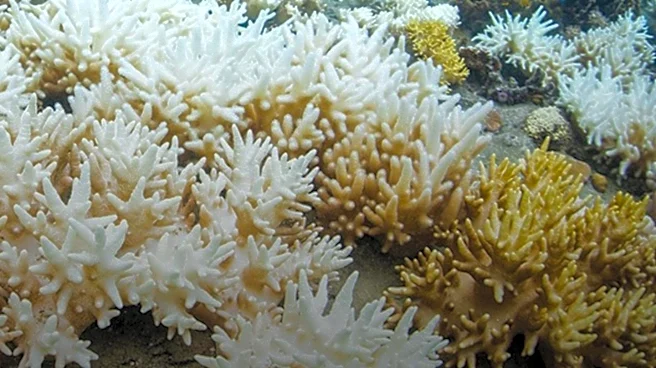
reefs and fish populations, and can intensify cyclones. The definition of a marine heatwave is relative, meaning the threshold is set by each location's historical temperature readings for a specific season, rather than a fixed global temperature. When these heatwaves occur, corals can bleach by expelling their symbiotic algae, leading to their potential death. Additionally, fish kills can occur in large numbers due to the unusually warm water, impacting fishing communities and food security. The tropical Indian Ocean is experiencing the fastest warming among tropical oceans, increasing the risk of such events in that region, with similar impacts observed globally.
Why It's Important?
The increasing frequency of marine heatwaves has profound implications for U.S. coastal communities and industries. Fisheries, a vital economic sector in many coastal states, face significant disruptions due to fish kills and habitat degradation. Coral reefs, which serve as critical ecosystems supporting diverse marine life and protecting coastlines from erosion, are particularly vulnerable to bleaching and mortality. This loss of biodiversity can have cascading effects throughout the marine food web. Furthermore, warmer sea surface temperatures can fuel stronger cyclones, posing increased risks to coastal infrastructure and human populations in regions susceptible to tropical storms. The economic impact extends to tourism, as healthy marine ecosystems are a major draw for coastal economies. Addressing global warming through reduced greenhouse gas emissions is identified as the primary solution to mitigate these growing threats.
What's Next?
The ongoing trend of global warming suggests that marine heatwaves will continue to increase in frequency and intensity throughout the 21st century, as projected by the IPCC AR6. This necessitates continued monitoring of sea surface temperatures and the health of marine ecosystems. Policy responses will likely focus on two main areas: global efforts to cut greenhouse gas emissions to address the root cause of warming, and local conservation strategies. Local efforts may include establishing and expanding marine protected areas, reducing pollution from agricultural runoff and sewage, and implementing sustainable fishing practices to alleviate other stressors on marine life. International agreements, such as the BBNJ Agreement, which allows for the creation of marine protected areas on the high seas, will play a role in broader conservation efforts aimed at enhancing the resilience of marine ecosystems.
Beyond the Headlines
Beyond the immediate ecological and economic impacts, marine heatwaves highlight the interconnectedness of global climate systems and local environmental health. The concept of the 'deadly trio'—marine heatwaves, ocean acidification, and deoxygenation—underscores how multiple stressors interact to push marine ecosystems towards collapse. This complex interplay presents significant challenges for conservation and management, requiring integrated approaches that consider all these factors. The disproportionate impact on vulnerable ecosystems like coral reefs, which are often biodiversity hotspots, raises ethical questions about stewardship of natural resources and the long-term consequences for future generations. The scientific definition of marine heatwaves, based on relative temperature thresholds, also emphasizes the importance of localized data and historical context in understanding and responding to climate change impacts, moving beyond simplistic, fixed temperature metrics.