



What's Happening?
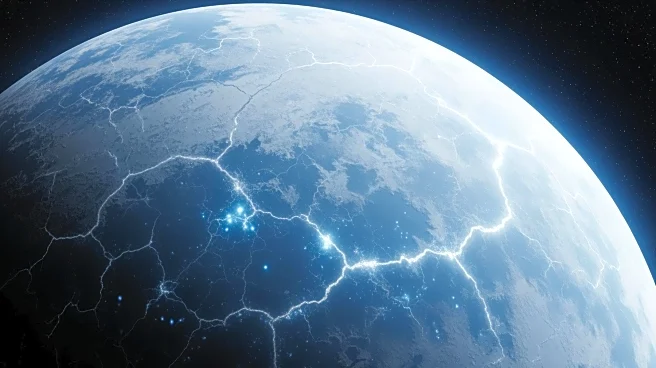
NASA's Jet Propulsion Laboratory has revealed new findings from the Galileo mission, indicating the presence of ammonia-bearing compounds on Jupiter's moon Europa. The data, originally collected in 1997, was re-analyzed and showed faint signals of ammonia near
cracks on Europa's icy surface. This discovery is significant as ammonia is a nitrogen-bearing molecule, essential for life as we know it. Europa, the fourth-largest moon of Jupiter, is believed to have a vast, salty ocean beneath its icy crust, making it a prime candidate for hosting extraterrestrial life. The ammonia may have originated from Europa's subsurface ocean or shallow subsurface, as it is quickly broken down by ultraviolet light and cosmic radiation.
Why It's Important?
The detection of ammonia on Europa is crucial for astrobiology, as it suggests potential habitability of the moon. Ammonia's presence indicates that Europa's subsurface ocean might contain life-supporting elements. This finding enhances the scientific community's interest in Europa as a location for future exploration and study. The implications extend to understanding the conditions necessary for life beyond Earth, potentially guiding future missions aimed at discovering extraterrestrial life. The Europa Clipper mission, set to arrive in 2030, will further investigate these chemical signs of habitability, potentially revolutionizing our understanding of life in the solar system.
What's Next?
NASA's Europa Clipper mission, launched in October 2024, is expected to reach the Jupiter system by April 2030. This mission will focus on analyzing Europa's surface and subsurface for chemical signs of habitability. The findings from the Galileo mission will inform the Clipper's objectives, potentially leading to groundbreaking discoveries about Europa's ability to support life. The mission will employ advanced instruments to study the moon's ice shell and ocean, providing deeper insights into its geophysical properties and potential for life.
Beyond the Headlines
The discovery of ammonia on Europa raises questions about cryovolcanism, which may have pushed these compounds to the surface. This process could reveal more about the moon's geological activity and its ability to sustain life. Additionally, the findings highlight the importance of re-examining older datasets with new technologies, as they can yield significant scientific insights. The study of Europa's habitability also contributes to broader discussions about the ethical considerations of exploring and potentially contaminating extraterrestrial environments.