
What's Happening?
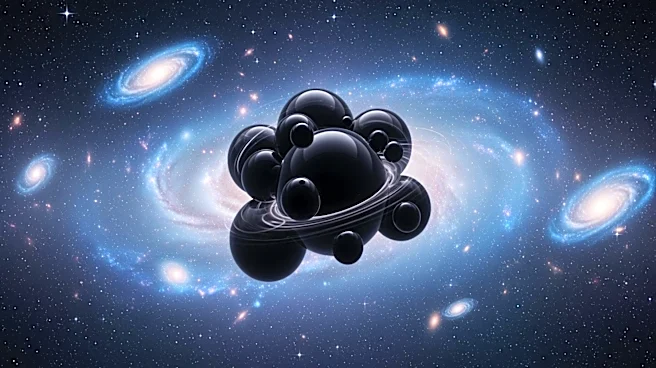
A study by scientists at the University of California Riverside suggests that the decay of dark matter could have played a crucial role in the formation of supermassive black holes in the early universe.
The research, led by grad student Yash Aggarwal, proposes that dark matter particles could inject small amounts of energy into gas clouds, potentially initiating the black hole formation process. This theory could explain the presence of supermassive black holes observed by the James Webb Space Telescope in early cosmic epochs, which appear too massive to have formed through conventional means in the available time. The study uses computer models to simulate the effects of decaying axions, a dark matter candidate, on the thermo-chemical dynamics of early hydrogen gas.
Why It's Important?
Understanding the formation of early supermassive black holes is a significant challenge in cosmology. This research offers a potential explanation that bridges the gap between theoretical predictions and observational data. If dark matter decay is indeed responsible for these early black holes, it could reshape our understanding of the universe's evolution and the role of dark matter. This insight could lead to new approaches in studying dark matter and its properties, influencing future astronomical research and potentially guiding the development of new observational technologies.
What's Next?
Future observations using the James Webb Space Telescope and other instruments could provide further evidence to support or refute this theory. Continued research may uncover more supermassive black holes from even earlier times, offering additional data to refine models of dark matter's role in cosmic evolution. This ongoing investigation could eventually lead to a more comprehensive understanding of dark matter and its impact on the universe's history.