


What's Happening?
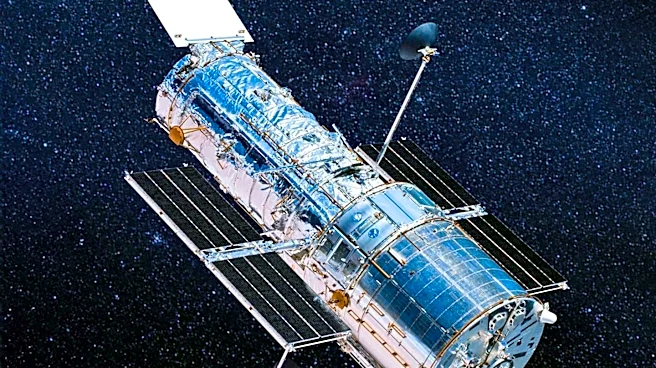
The Hubble Space Telescope has captured images of NGC 4698, a spiral galaxy located in the Virgo Cluster approximately 60 million light-years away. Astronomers have noted an unusual characteristic: the galaxy's central core and its innermost gas rotate
almost perpendicularly to its main disk. This 'out of sync' rotation suggests a turbulent past for NGC 4698. While appearing as a normal spiral galaxy with dust lanes and young, massive stars, kinematic measurements confirm that the stars and gas near the center rotate on an axis nearly perpendicular to the galaxy's primary component. This observation is part of the MAUVE (Multiphase Astrophysics to Unveil the Virgo Environment) project, which utilizes the Hubble Space Telescope to study how galaxy clusters influence galactic evolution. The project aims to reveal details within individual galaxies in the Virgo Cluster, which contains thousands of galaxies bound by gravity.
Why It's Important?
This discovery challenges conventional understandings of galaxy formation and evolution. The perpendicular rotation of NGC 4698's core suggests that external events, such as ancient collisions or the capture of gas with different angular momentum, can significantly alter a galaxy's structure and dynamics. This provides crucial data for refining astrophysical models that simulate galactic development. Understanding such anomalies helps scientists piece together the complex history of the universe, including how galaxies merge and interact over billions of years. The MAUVE project, by identifying such unusual galaxies, contributes to a broader understanding of the environmental factors that shape galactic characteristics, offering insights into the processes that lead to the diverse range of galaxies observed today. This research is vital for astronomers seeking to explain the origins and transformations of cosmic structures.
What's Next?
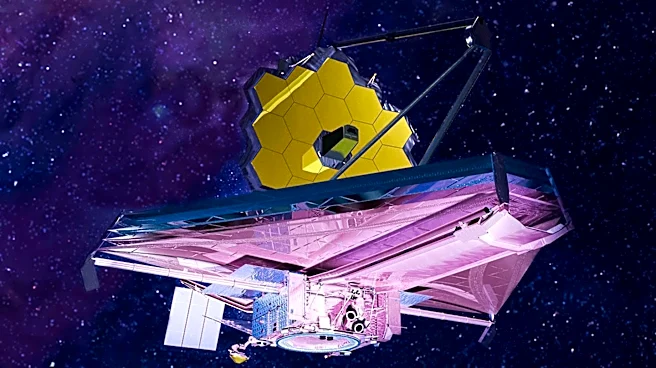
Astronomers will continue to analyze data from NGC 4698 and other unusual galaxies observed by the Hubble Space Telescope as part of the MAUVE project. Further studies will likely focus on developing more detailed simulations to test the hypotheses of ancient collisions or gas capture as explanations for the observed out-of-sync rotation. The findings from NGC 4698 could inform future observations by other advanced telescopes, such as the James Webb Space Telescope, which can provide even deeper insights into the early universe and galactic interactions. The ongoing collection of data from the Virgo Cluster will help build a more comprehensive picture of how environmental factors within galaxy clusters influence the evolution of their constituent galaxies, potentially leading to new theories about cosmic dynamics.
Beyond the Headlines
The observation of NGC 4698's peculiar rotation highlights the dynamic and often violent nature of the universe. It underscores that the seemingly orderly appearance of galaxies can mask a history of significant gravitational interactions and mergers. This finding has implications for our understanding of dark matter distribution and its role in galactic stability, as gravitational forces are central to these processes. The ability of the Hubble Space Telescope to detect such subtle yet profound anomalies, even after decades of operation, demonstrates its enduring value in astrophysics. This continuous stream of new discoveries pushes the boundaries of human knowledge about the cosmos, reminding us that much remains to be uncovered about the fundamental forces and events that shaped the universe we inhabit.