
What's Happening?
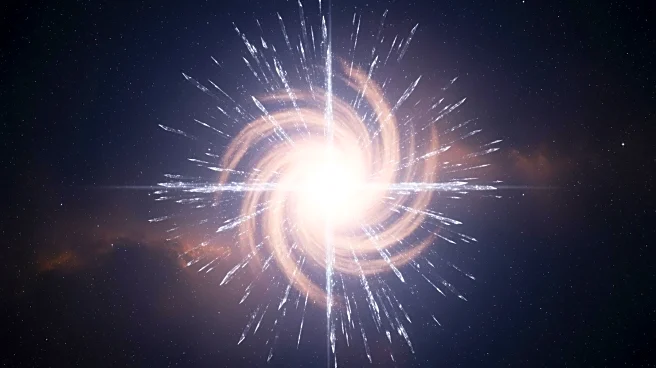
NASA's James Webb Space Telescope has captured images of a protostar, EC 53, in the Serpens Nebula, revealing the formation of crystalline silicates. These crystals, typically found in comets, require
intense heat to form, yet are present in the cold regions of the Kuiper Belt and Oort Cloud. The telescope's observations show that these crystals are formed in the hot, inner part of the protostar's disk and are carried to the outer edges by strong outflows. This discovery provides new insights into the conditions that lead to crystal formation in space.
Why It's Important?
The findings from the James Webb Space Telescope offer a deeper understanding of the processes that occur during star formation and the early stages of solar system development. By identifying the mechanisms behind crystal formation, scientists can better understand the composition and evolution of comets and other celestial bodies. This research contributes to our knowledge of the solar system's history and the conditions that may support life. The telescope's ability to capture detailed images of distant objects continues to advance our understanding of the universe.
What's Next?
Further observations by the James Webb Space Telescope will continue to explore the formation and evolution of stars and planetary systems. Scientists will analyze the data to refine models of star and planet formation, enhancing our understanding of the universe's origins. The telescope's capabilities will also be used to study other phenomena, such as exoplanets and distant galaxies, providing valuable insights into the cosmos. Ongoing research will help answer fundamental questions about the universe and our place within it.