







What's Happening?
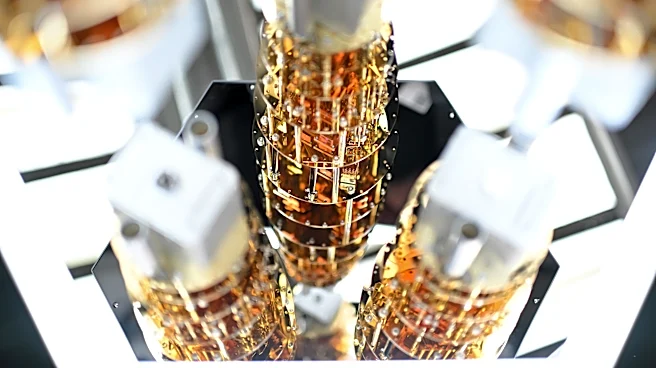
Researchers at Paderborn University, led by Dr. Christine Silberhorn, have published new findings on the fundamental quantum resources that shape the performance of photonic quantum computers. Using Germany's first scalable photonic quantum computer,
a 'Gaussian boson sampler' named 'Paderborn Quantum Sampler (PaQS),' the team investigated how properties like squeezed light, photon statistics, and entanglement influence computational capabilities. This research goes beyond simply demonstrating a large-scale quantum system by analyzing the contribution of individual quantum resources to the device's performance. The PaQS system is a flexibly programmable platform that allows researchers to configure photonic networks for various experiments, enabling the exploration of new approaches and potential applications in quantum computing.
Why It's Important?
This research is important because it provides crucial insights into optimizing the performance of photonic quantum computers, which have the potential to revolutionize fields from energy and chemical research to secure communications. Understanding which quantum resources are most critical for computational performance is essential for developing the next generation of quantum technologies. By identifying these key factors, scientists can design more efficient and powerful quantum computers, accelerating the ability to solve highly complex mathematical problems that are currently beyond the reach of even the most powerful supercomputers. This fundamental understanding is vital for advancing the practical application of quantum computing and ensuring its effective development in the U.S. and globally.
What's Next?
The Paderborn University team plans to continue expanding the PaQS system to support more complex calculations and investigate further potential applications for photonic quantum computing. Future research will likely focus on leveraging the insights gained about quantum resources to enhance the capabilities of photonic quantum computers. This includes refining the control over properties like squeezed light and entanglement to maximize computational efficiency. The programmable nature of PaQS will allow for continuous experimentation and the testing of new theoretical frameworks. The findings are expected to contribute to the broader quantum computing community, guiding the development of more effective and scalable photonic quantum systems worldwide.
Beyond the Headlines
Beyond the immediate technical advancements, this research highlights the ongoing global race in quantum technology development. While this specific research is based in Germany, the fundamental insights gained are universally applicable and contribute to the collective knowledge base of quantum computing. The ability to precisely understand and manipulate quantum resources underscores the intricate scientific challenges involved in building practical quantum computers. This work also emphasizes the interdisciplinary nature of quantum research, combining expertise in integrated photonics, computer science, and theoretical quantum optics. The long-term implications include the potential for entirely new computational paradigms and the creation of technologies that could redefine industries and scientific exploration, impacting U.S. technological leadership and economic growth.