
What's Happening?
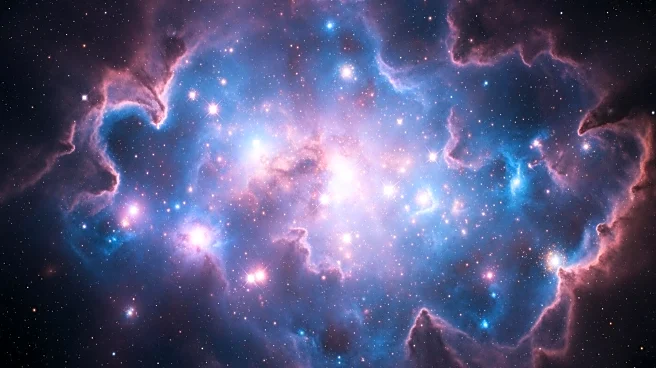
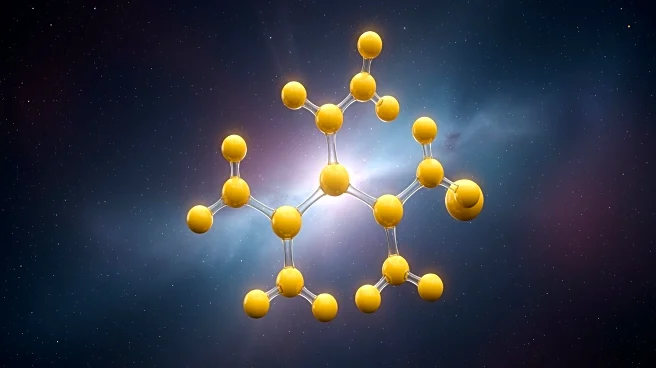
Astronomers from the Max Planck Institute for Extraterrestrial Physics and the CSIC-INTA Centro de Astrobiología have discovered a complex sulfur-bearing molecule, thiepine, in the molecular cloud G+0.693-0.027,
located near the center of the Milky Way. This molecule, a ring-shaped sulfur-bearing hydrocarbon, is the largest sulfur-bearing molecule detected beyond Earth. The discovery was made by combining astronomical observations with laboratory experiments, confirming the presence of this molecule in a star-forming region. The detection of thiepine, which is structurally related to molecules found in meteorite samples, marks a significant step in understanding the chemical link between space and the building blocks of life.
Why It's Important?
The discovery of thiepine in interstellar space is crucial as it provides evidence of complex organic chemistry occurring in space, which is linked to the origins of life on Earth. This finding suggests that the chemical groundwork for life begins long before stars form, indicating that the building blocks of life are more widespread in the universe than previously thought. The presence of such complex molecules in space supports the theory that life's essential components could have been delivered to Earth via meteorites, thus playing a role in the emergence of life. This research enhances our understanding of astrochemistry and its connection to biological processes.
What's Next?
The discovery opens up new avenues for research into the presence of other complex sulfur-bearing molecules in interstellar space. Scientists may focus on identifying additional molecules that could further bridge the gap between space chemistry and terrestrial life. Future studies could involve more detailed observations using advanced telescopes and laboratory simulations to explore the formation and distribution of these molecules. This research could lead to a deeper understanding of the processes that contribute to the formation of life-supporting environments in the universe.
Beyond the Headlines
The detection of thiepine highlights the potential for discovering more complex organic molecules in space, which could reshape our understanding of life's origins. This finding also raises questions about the universality of life's building blocks and whether similar processes could occur elsewhere in the universe, potentially leading to life beyond Earth. The research underscores the importance of interdisciplinary collaboration between astronomers and chemists to unravel the mysteries of the cosmos and its connection to life.