



What's Happening?
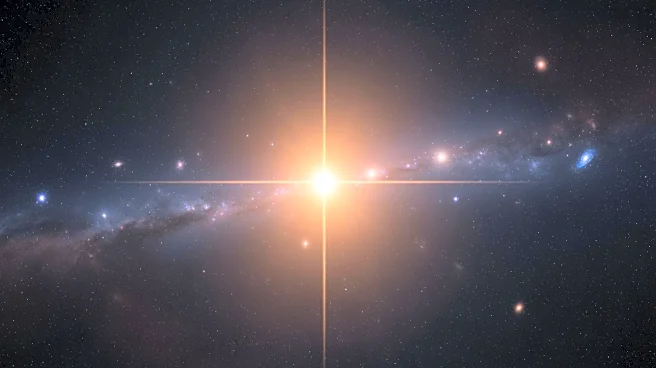
Astronomers have identified an ancient star in the dwarf galaxy Pictor II using the James Webb Space Telescope (JWST). This star, estimated to be over 13 billion years old, formed shortly after the Big Bang, providing a rare glimpse into the early universe.
The star's composition, primarily hydrogen and helium, is characteristic of Population II stars, which are among the first generations of stars. The discovery offers valuable insights into the conditions of the early universe and the formation of the first stars. Dr. Sarah Caldwell from the University of Cambridge highlighted the significance of this finding, noting that the star acts as a 'time capsule' that reveals information about the primordial universe.
Why It's Important?
The identification of such an ancient star is crucial for understanding the early stages of star formation and the chemical evolution of the universe. By studying this star, astronomers can gain insights into how the first heavy elements were produced and distributed across the cosmos. The data obtained from this star helps refine cosmological models of galaxy formation and stellar evolution. This discovery underscores the capabilities of modern telescopes like the JWST in uncovering remnants of the early universe, enhancing our understanding of cosmic origins and the processes that shaped the universe as we know it today.
What's Next?
Researchers plan to survey additional dwarf galaxies to identify more ancient stars, which could provide further insights into the early universe. They aim to compare the chemical signatures of these stars with theoretical models to better understand the conditions that prevailed shortly after the Big Bang. Additionally, scientists are interested in investigating whether such stars could have hosted primitive planetary systems, which would shed light on the potential for early habitability in the universe. These efforts will contribute to a more comprehensive understanding of the universe's history and the factors that influenced the development of galaxies and stars.