

What's Happening?
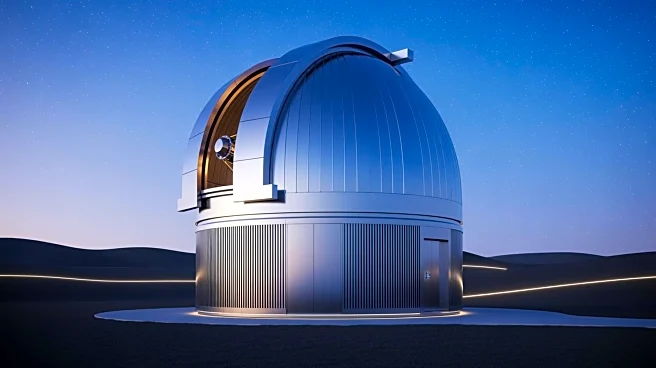
The Vera Rubin Observatory in Chile, a project envisioned by physicist Tony Tyson over 30 years ago, is poised to revolutionize the field of astronomy. Recently, Tyson previewed the first images captured by the observatory, which revealed thousands of galaxies
in stunning detail. The observatory, located on Cerro Pachón in the Andes, is equipped with the world's largest digital camera and is designed to create a continuous video of the southern sky. This innovative telescope will map the Universe's dark matter in three dimensions, detect millions of stars, and identify potentially hazardous asteroids. Despite its massive 350-tonne weight, the telescope's compact design allows it to capture new exposures every 40 seconds. The project, which cost $810 million, was a high-risk venture that Tyson championed despite initial skepticism.
Why It's Important?
The Vera Rubin Observatory represents a significant advancement in astronomical research, particularly in the study of dark matter and dark energy. By providing a detailed 3D map of dark matter, the observatory will enhance our understanding of the Universe's structure and evolution. The ability to detect and monitor asteroids also has practical implications for Earth's safety. The observatory's innovative use of charge-coupled device (CCD) sensors, which Tyson helped pioneer, underscores the importance of technological advancements in scientific discovery. This project not only highlights the potential for groundbreaking research but also demonstrates the value of perseverance and vision in scientific endeavors.
What's Next?
As the Vera Rubin Observatory begins its operations, the scientific community anticipates a wealth of new data that could lead to significant discoveries in cosmology and astrophysics. Researchers will likely focus on analyzing the observatory's findings to gain insights into dark matter, dark energy, and the potential threats posed by near-Earth objects. The observatory's success may also inspire further investment in similar large-scale scientific projects, encouraging collaboration across international borders. Additionally, the data collected could lead to new theories and models that challenge existing paradigms in astronomy.
Beyond the Headlines
The development of the Vera Rubin Observatory also raises questions about the ethical and environmental implications of large-scale scientific projects. The construction and operation of such facilities can impact local ecosystems and communities, necessitating careful consideration of sustainability practices. Furthermore, the observatory's findings may influence philosophical and cultural perspectives on humanity's place in the Universe, as new discoveries challenge our understanding of cosmic phenomena. The project exemplifies the intersection of science, technology, and society, highlighting the need for responsible stewardship of scientific advancements.