

What's Happening?
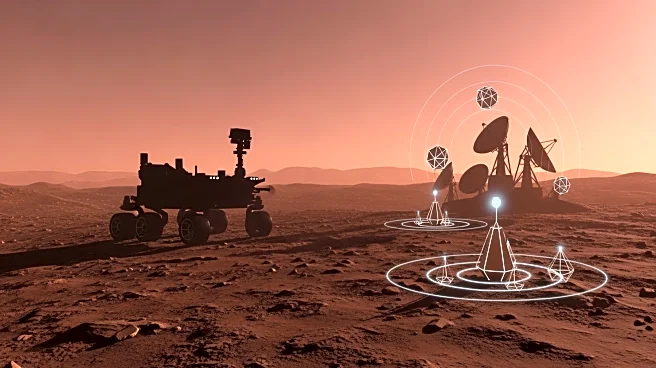
NASA's Perseverance Mars rover has successfully pinpointed its location on the Red Planet using a new technology called Mars Global Localization. This technology allows the rover to autonomously determine its position by matching panoramic images captured
by its navigation cameras with orbital imagery from NASA's Mars Reconnaissance Orbiter (MRO). The rover achieved this feat on February 2, 2026, in a relatively featureless area known as 'Mala Mala' on the rim of Jezero Crater. The Mars Global Localization algorithm, developed by NASA's Jet Propulsion Laboratory, enables the rover to accurately locate itself within 10 inches, significantly improving its navigation capabilities.
Why It's Important?
The ability of the Perseverance rover to autonomously determine its location marks a significant advancement in Mars exploration technology. This capability reduces the reliance on Earth-based navigation, allowing the rover to operate more efficiently and explore more challenging terrains. By enhancing the rover's autonomy, NASA can conduct more complex scientific missions and gather valuable data about Mars' geology and climate. This development also sets the stage for future Mars missions, including potential human exploration, by demonstrating the feasibility of autonomous navigation on the Martian surface.
What's Next?
With the successful implementation of Mars Global Localization, the Perseverance rover is expected to continue its exploration of Jezero Crater, focusing on areas of scientific interest. The rover's enhanced navigation capabilities will enable it to traverse more difficult terrains and conduct detailed analyses of Martian rocks and soil. NASA will continue to refine and expand the use of autonomous technologies in its Mars missions, paving the way for more ambitious exploration goals, including the search for signs of past life and the preparation for human missions to Mars.