




What's Happening?
The California Coastal Commission has approved an extensive 10-year coastal development permit aimed at protecting a critical railway line in San Clemente, which has been repeatedly threatened by rising seas, harsh waves, and strong storms. A key component
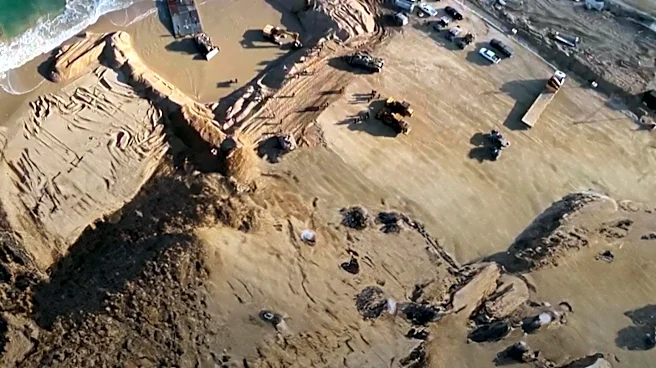
of the permit is the placement of nearly 700,000 cubic yards of sand on shrinking beaches, marking the largest sand replenishment project in over 60 years for this coastal stretch. The permit also includes plans by the Orange County Transportation Authority (OCTA) to fortify the rail line with a 1,200-foot seawall and maintain or remove existing rock piles (riprap) and tiebacks. Orange County Supervisor Katrina Foley emphasized that sand replenishment is the long-term solution to protect the rail line and beaches, acknowledging past efforts focused on 'hardening' the beach exacerbated erosion.
Why It's Important?
This approval is crucial for maintaining a vital transportation artery in Southern California, which has experienced cumulative closures of 12 months since 2021 due to erosion and bluff failures. The railway, operating since 1888, is a significant part of the region's infrastructure, serving both passenger and freight transport. The project represents a substantial investment in coastal resilience, with $300 million in state and federal funding already secured. It highlights the ongoing challenges faced by coastal communities and infrastructure due to climate change and extreme weather events. The balance between protecting critical infrastructure and preserving natural coastal environments is a central theme, as the permit also mandates monitoring the sand replenishment's effectiveness and studying potential relocation options for the rail line in the long term. This decision sets a precedent for how California addresses similar coastal erosion issues impacting essential services.
What's Next?
With the permit approved, the major sand replenishment project could commence as early as January. The Orange County Transportation Authority will proceed with the construction of the 1,200-foot seawall and manage the existing riprap and tiebacks according to the permit's stipulations. Over the next five years, railway owners and operators are required to monitor and report on the efficacy of the sand replenishment. Crucially, the permit also mandates studies into the long-term future of the rail line, including examining potential relocation options. This indicates a recognition that while immediate measures are necessary, a more sustainable, long-term strategy for the railway's future in the face of ongoing coastal erosion is essential. Stakeholders, including environmental groups, will likely continue to monitor the project's impact on the coastline and public access.
Beyond the Headlines
This project underscores the escalating costs and complexities of maintaining coastal infrastructure in an era of climate change. The debate between 'hardening' the coastline with structures like seawalls versus 'soft' solutions like sand replenishment reflects a broader national discussion on coastal management strategies. While sand replenishment offers ecological benefits by restoring beaches, its long-term effectiveness is often debated due to natural processes like erosion and the need for continuous maintenance. The requirement to study potential relocation of the railway signals a growing acknowledgment that some coastal infrastructure may eventually become unsustainable in its current location. This could lead to difficult policy decisions regarding land use, property rights, and funding for managed retreat strategies in vulnerable coastal areas across the U.S., setting a precedent for how communities adapt to permanent environmental shifts rather than just mitigating immediate threats.