
What's Happening?
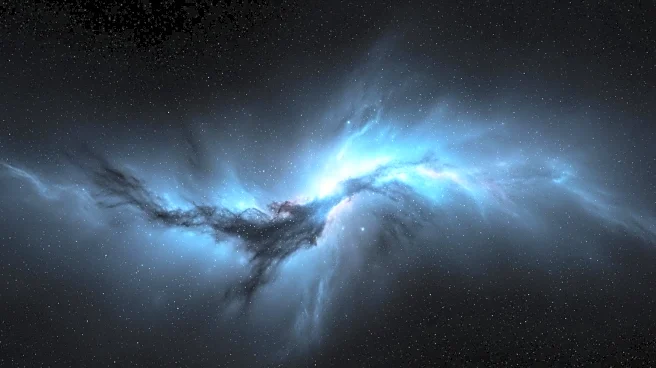
NASA has announced the discovery of a unique space object, 'Cloud-9', located 14 million light-years from Earth. This 'starless, gas-rich, dark-matter cloud' was identified using the Hubble Space Telescope.
The discovery is significant as it represents the first confirmed detection of such an object, providing insights into galaxy formation, the early universe, and the nature of dark matter. The findings were presented at the 247th meeting of the American Astronomical Society. According to astronomer Andrew Fox, Cloud-9 offers a rare glimpse into a dark-matter-dominated cloud, which is typically difficult to detect due to its lack of light emission. The cloud is considered a 'failed galaxy', a primordial building block that hasn't formed into a galaxy. The core of Cloud-9 is composed of neutral hydrogen, with a mass approximately one million times that of the sun. It is associated with the nearby spiral galaxy Messier 94.
Why It's Important?
The discovery of Cloud-9 is pivotal for understanding the universe's dark components, which are not easily observed through conventional means. This finding could lead to the identification of other 'failed galaxies', enhancing our comprehension of galaxy formation and the role of dark matter. The research provides a more complete picture of the universe's structure, beyond the visible stars and galaxies. This could have implications for astrophysics, potentially influencing theories about the universe's evolution and the distribution of dark matter. The study of such objects may also inform future astronomical research and technology development.