




What's Happening?
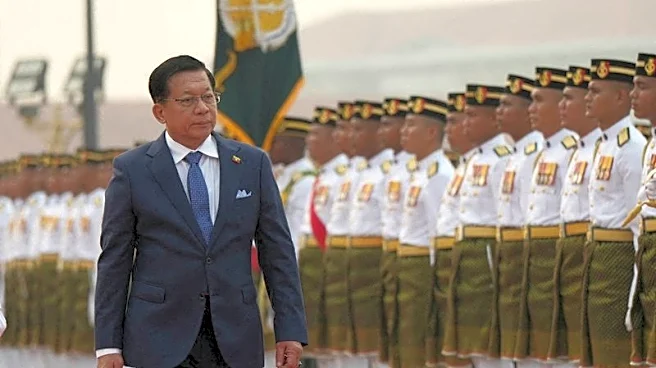
On November 4, 2026, Maxim Ryzhenkov, the Minister of Foreign Affairs of the Republic of Belarus, held a meeting with Tin Maung Swe, the Union Minister for Foreign Affairs of the Republic of the Union of Myanmar. The meeting took place during Tin Maung Swe's
visit to Belarus to attend the 4th Minsk International Conference on Eurasian Security. During their discussion, the two ministers reviewed the preliminary outcomes of the conference and exchanged views on various matters concerning global and regional security. They also addressed current issues on the bilateral agenda between Belarus and Myanmar, with a particular focus on the implementation of previously established agreements. Additionally, they identified strategies to enhance efforts in executing joint projects within the trade and economic sectors.
Why It's Important?
This meeting signifies Belarus's active engagement in international diplomacy, particularly with countries outside traditional Western alliances. For the U.S., this interaction highlights the evolving geopolitical landscape where nations like Belarus are strengthening ties with countries in Southeast Asia. The discussion on global and regional security, alongside trade and economic cooperation, indicates a broader strategy by Belarus to diversify its international partnerships and potentially reduce reliance on specific blocs. This could have implications for U.S. foreign policy, as it suggests a growing network of non-aligned or strategically independent nations that might challenge existing international norms or influence. The emphasis on implementing joint trade and economic projects also points to efforts to build economic resilience and alternative supply chains, which could impact global trade dynamics.
What's Next?
The meeting concluded with an agreement to intensify efforts on implementing joint projects in the trade and economic sphere. This suggests that both Belarus and Myanmar will likely pursue further collaboration in these areas, potentially leading to new trade agreements, investment opportunities, and economic partnerships. The ongoing discussions at the 4th Minsk International Conference on Eurasian Security indicate a continued focus on regional and global security issues, which may lead to further diplomatic engagements and coordinated actions between participating nations. The emphasis on implementing previously reached agreements suggests a commitment to follow through on existing diplomatic and economic commitments, which could solidify the relationship between Belarus and Myanmar.
Beyond the Headlines
The engagement between Belarus and Myanmar, particularly in the context of a Eurasian security conference, reflects a broader trend of nations seeking to forge new alliances and strengthen existing ones in a multipolar world. This move could be interpreted as an effort by both countries to assert greater autonomy in their foreign policy and economic relations, potentially moving away from the influence of larger global powers. The focus on trade and economic projects suggests a strategic effort to build economic resilience and create alternative markets, which could have long-term implications for global economic structures. This development might also signal a shift in diplomatic priorities, where regional security concerns are increasingly addressed through diverse international partnerships, potentially challenging established security frameworks and alliances.