





What's Happening?
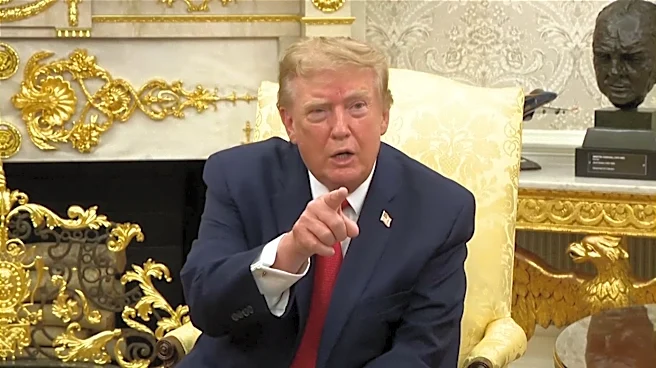
Sarah Matthews, who served as Deputy Press Secretary during President Trump's first term, has voiced concerns regarding the close relationship between White House staffer Natalie Harp and President Trump. Matthews stated on CNN's 'Laura Coates Live' that
Harp's proximity to President Trump 'unnerved' the Secret Service and made his 2024 campaign team uneasy. These comments follow remarks by Democratic Senator Jon Ossoff, who criticized President Trump for prioritizing travel with Harp over his duties, particularly amidst global tensions. Matthews also recounted efforts by President Trump's 2024 campaign to prevent Harp from staying at his Bedminster golf club, suggesting an unusual dynamic. Harp's brother, Preston Harp, indicated that his sister's strong support for President Trump stems from a lifelong fascination with the presidency and patriotic ideals instilled during their upbringing, noting she had previously written letters to other presidents.
Why It's Important?
The concerns raised by Sarah Matthews and Senator Jon Ossoff regarding Natalie Harp's relationship with President Trump are significant for several reasons. Firstly, the involvement of the Secret Service in being 'unnerved' by Harp's proximity suggests potential security or operational concerns within the highest levels of government. Secondly, the unease expressed by President Trump's own campaign team highlights internal divisions and potential distractions that could impact campaign effectiveness and public perception. Senator Ossoff's criticism links Harp's presence to President Trump's perceived dereliction of duty during a period of international crisis, aiming to portray President Trump as disengaged. This narrative can undermine public confidence in leadership and raise questions about the decision-making environment surrounding the President. The situation also underscores the intense scrutiny faced by individuals within a presidential orbit and the political weaponization of personal relationships.
What's Next?
The ongoing discussions about Natalie Harp's role and relationship with President Trump are likely to continue, especially as the 2024 election cycle intensifies. President Trump's campaign and allies are expected to defend Harp and dismiss the criticisms as politically motivated, as evidenced by responses from Florida Representative Anna Paulina Luna and EPA head Lee Zeldin, who praised Harp's work ethic and loyalty. The White House communications director, Steven Cheung, and Press Secretary Karoline Leavitt have also publicly defended Harp. Conversely, opponents will likely continue to use these concerns to question President Trump's judgment and focus. The media will likely continue to investigate and report on the dynamics within President Trump's inner circle, potentially revealing further details or perspectives. The public discourse will likely remain polarized, with supporters and critics interpreting the situation through their respective political lenses.
Beyond the Headlines
Beyond the immediate political skirmishes, this situation illuminates deeper issues concerning the nature of presidential influence, staff loyalty, and the boundaries of personal relationships within the executive branch. The narrative of Harp's 'lifelong fascination' with the presidency and her 'patriotic ideals' offers a glimpse into the psychological motivations that draw individuals into the orbit of powerful political figures. It also highlights the potential for personal devotion to blur professional lines, creating an environment where critical distance might be compromised. The Secret Service's reported unease and the campaign team's efforts to manage Harp's presence underscore the complex interplay between personal access, security protocols, and political strategy. This scenario raises questions about the informal power structures that can exist alongside formal hierarchies in a presidential administration and the ethical considerations when personal relationships intersect with national security and governance.