
What's Happening?
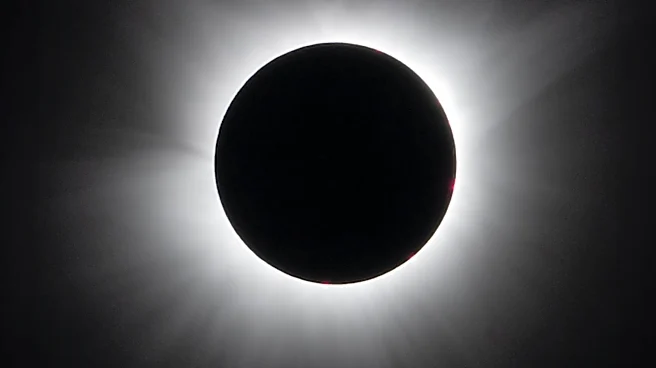
A total solar eclipse is set to occur on August 12, 2026, creating twilight-like conditions as the moon completely obscures the sun. This astronomical event will be visible across remote parts of the Arctic,
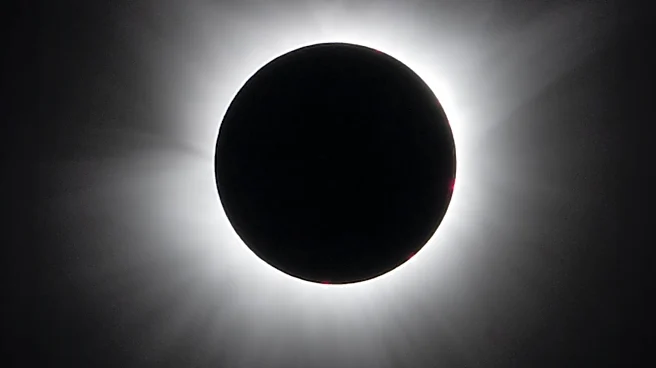
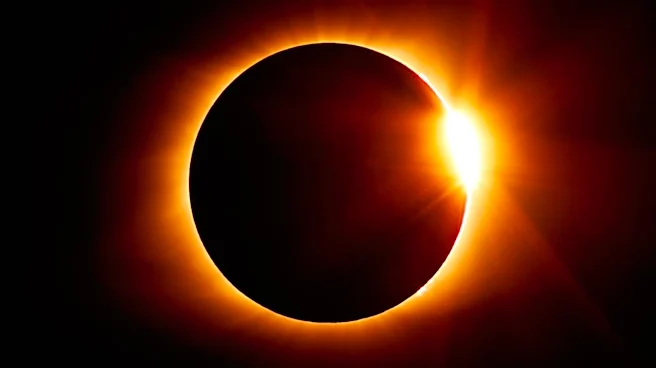
Greenland, Iceland, northern Russia, the Atlantic Ocean, Spain, and a small section of northwestern Portugal. During the eclipse, the moon will appear as a black disk surrounded by the sun's glowing corona, a phenomenon that can cause animals to react to the sudden change in light. The eclipse will begin at 4:58 p.m. UTC and end at 6:34 p.m. UTC, with the maximum totality lasting up to two minutes and 18 seconds. The event is notable for its rarity, as the alignment of the sun, moon, and Earth must be precise for a total eclipse to occur.
Why It's Important?
Total solar eclipses are rare and awe-inspiring events that offer unique opportunities for scientific observation and public engagement with astronomy. The 2026 eclipse will provide researchers with a chance to study the sun's corona, which is usually obscured by the sun's brightness. For the general public, the eclipse presents an opportunity to witness a natural phenomenon that can inspire interest in science and the cosmos. Economically, regions along the eclipse path may experience a boost in tourism as enthusiasts travel to witness the event. The eclipse also serves as a reminder of the intricate dynamics of our solar system and the precise conditions required for such celestial events.