






What's Happening?
Scientists have uncovered evidence suggesting that a colossal cliff, referred to as a 'mega-escarpment,' once stretched thousands of kilometers across ancient North America. This geological feature may explain the Grand Canyon's 'missing billion years'
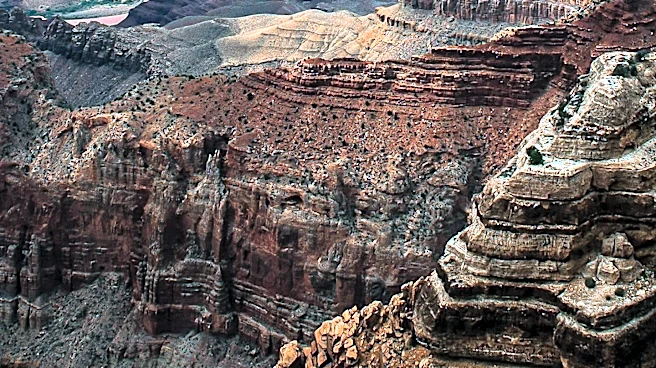
in its rock record. The study, led by the University of Southampton in the UK, proposes that this vast escarpment, approximately 1-kilometer-high (0.6-mile-high), formed when the supercontinent Rodinia fragmented 800 million years ago. This event led to immense erosion, exposing ancient crystalline basement rocks now visible in the Grand Canyon. Lead author Thomas Gernon, a professor of Earth science at Southampton, stated that the Canyon's basement rocks were brought to the surface as part of this immense escarpment. The findings, published in Geology, also shed light on the formation of the Great Unconformity, a significant gap in the geological record spanning over a billion years. The ancient escarpment is believed to have extended across what are now Arizona, Utah, Idaho, Wyoming, Colorado, Texas, Oklahoma, Arkansas, Missouri, and Illinois.
Why It's Important?
This research offers a groundbreaking explanation for one of geology's enduring mysteries: the Grand Canyon's 'missing billion years' and the Great Unconformity. By proposing the existence of an ancient mega-escarpment, scientists provide a coherent mechanism for the extensive erosion that removed vast quantities of rock, revealing the older basement layers. This understanding fundamentally alters our perception of North America's geological history and the processes that shaped its iconic landscapes. The study's methodology, combining plate tectonic reconstructions with landscape evolution data, demonstrates advanced scientific approaches to deciphering Earth's deep past. The implications extend beyond the Grand Canyon, potentially offering a framework for reinterpreting similar geological gaps in other continental interiors worldwide, thus advancing the broader field of geology and our comprehension of continental evolution over hundreds of millions of years.
What's Next?
Further research will likely focus on gathering more geological data from the regions identified as part of the ancient mega-escarpment, including Arizona, Utah, and other states. Scientists may seek to identify additional evidence, such as specific mineral compositions or erosional patterns, that corroborate the existence and scale of this ancient cliff system. The findings could also inspire new investigations into other areas with significant geological unconformities, applying similar analytical techniques to test the mega-escarpment hypothesis in different contexts. Collaborative efforts between international research institutions, like those involved in this study, are expected to continue, fostering a deeper understanding of Earth's ancient supercontinents and their breakup events. The scientific community will also engage in peer review and discussion to further validate and refine this significant geological theory.
Beyond the Headlines
The concept of a 'mega-escarpment' not only solves a geological puzzle but also paints a vivid picture of a dramatically different ancient North American landscape. This research highlights the immense, slow-acting forces that continually reshape our planet, often on timescales incomprehensible in human terms. The Great Unconformity, now potentially explained by this escarpment, has long been a source of fascination and debate, representing a vast stretch of Earth's history that was seemingly erased. Understanding such profound geological events can deepen our appreciation for the dynamic nature of Earth and the intricate interplay of tectonic forces, erosion, and climate over eons. It also underscores the continuous process of scientific discovery, where new evidence and innovative analytical methods can fundamentally alter long-held geological paradigms.