



What's Happening?
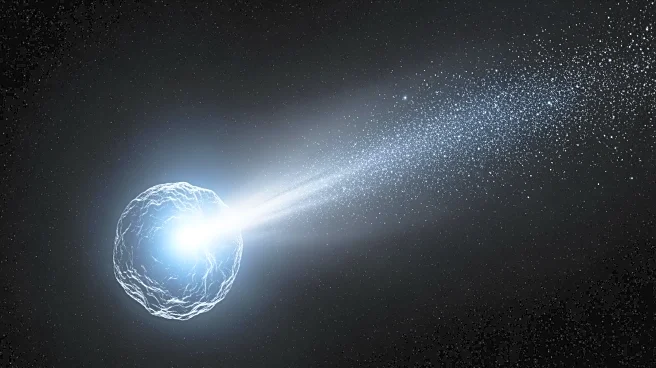
The Hubble Space Telescope has recently captured detailed images of the interstellar comet 3I/ATLAS, revealing its active behavior and complex structure, including jets, dual tails, and a puzzling 'heartbeat.' These observations, made on November 30,
2025, when the comet was about 286 million kilometers from Earth, are part of a collaborative effort between NASA and ESA's Juice mission. Hubble's images show the comet as a sharp dot against streaks of background stars, highlighting its rapid movement. The comet's activity and unique features are being studied extensively to understand interstellar objects better.
Why It's Important?
The study of 3I/ATLAS is significant as it is only the third confirmed interstellar object observed passing through our Solar System. Understanding its composition and behavior provides insights into the chemistry and dynamics of objects from other star systems. The comet's unique features, such as its anti-tail and jets, challenge existing models of cometary behavior and offer a rare opportunity to study the interactions of interstellar objects with the Sun. This research could enhance our understanding of planetary formation and the potential for similar objects to impact Earth.
What's Next?
Hubble will continue to monitor 3I/ATLAS as it moves away, and the James Webb Space Telescope is scheduled to examine the comet's infrared spectrum to identify specific ices and organics. ESA's Juice mission will also provide detailed data on the comet's gas composition and dust properties in early 2026. These observations will help refine models of the comet's jets, anti-tail, and rotation, contributing to a deeper understanding of its structure and behavior.
Beyond the Headlines
The observations of 3I/ATLAS have sparked discussions about the potential for interstellar objects to carry primitive materials that could have seeded life on Earth. The comet's behavior, including its 'heartbeat,' has led to speculative theories about its nature, though current evidence supports a natural explanation. The study of 3I/ATLAS also serves as a testbed for international collaboration and rapid scientific response to transient astronomical events.