



What's Happening?
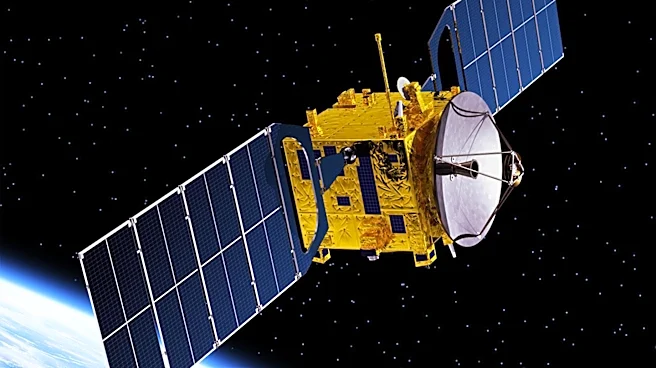
NASA's upcoming Nancy Grace Roman Space Telescope, named after NASA's first chief of astronomy, is designed to offer unprecedented observational capabilities, effectively acting as a successor to the Hubble Space Telescope. While possessing a mirror of the same
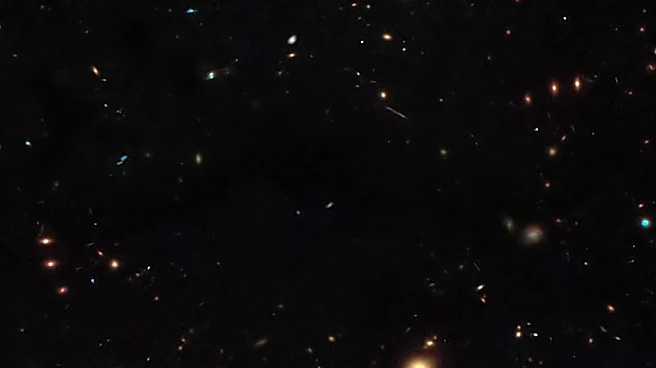
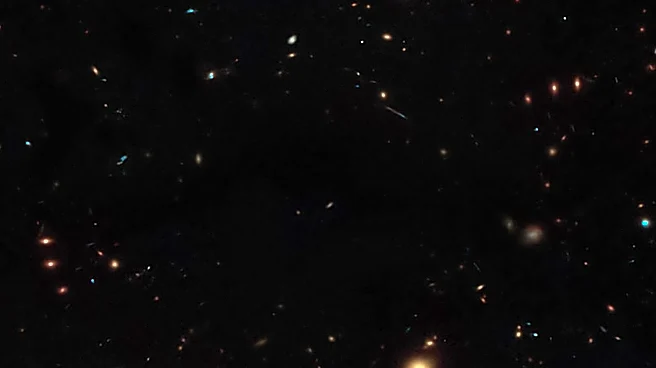
size as Hubble and observing in visible and infrared light, Roman distinguishes itself by being able to observe a patch of sky up to 200 times larger. This wide field of view, combined with sharp imaging and repeated observations, will allow astronomers to capture changes in the night sky almost like a high-definition cosmic movie. Unlike telescopes that sacrifice spatial resolution for a wider view or vice versa, Roman is notable for combining both high resolution and a broad field of view. Its core surveys, the High-Latitude Time-Domain Survey and the Galactic Bulge Time-Domain Survey, will focus on distant phenomena like supernovae and monitoring the packed center of the Milky Way, respectively.
Why It's Important?
The Nancy Grace Roman Space Telescope represents a significant leap forward in astronomical observation, promising to revolutionize our understanding of the dynamic universe. Its ability to combine a wide field of view with high resolution will enable discoveries that were previously impossible, such as finding approximately 100,000 transiting planets in the galactic bulge through the transit method. This will dramatically expand the known exoplanet population and provide crucial data for understanding planetary formation and habitability. Furthermore, Roman's capacity for repeated observations will allow scientists to study transient phenomena, from supernovae in distant galaxies to the rotation and activity of the smallest stars in our own Milky Way. This will provide insights into stellar evolution, dark energy, and the distribution of matter in the universe, solidifying the U.S.'s leadership in space science and potentially leading to groundbreaking discoveries that reshape cosmological models.
What's Next?
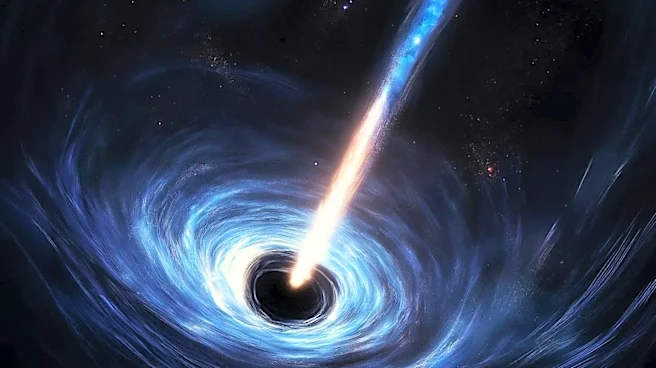
Upon its launch, the Nancy Grace Roman Space Telescope will embark on its primary mission to conduct wide-field surveys of the universe. Its two core surveys, the High-Latitude Time-Domain Survey and the Galactic Bulge Time-Domain Survey, will begin collecting vast amounts of data. Astronomers will utilize this data to identify distant supernovae, study microlensing events caused by passing objects like stars, planets, and black holes, and detect a multitude of transiting exoplanets. The telescope's repeated observations will allow for the tracking of changes in celestial objects over time, providing dynamic insights into cosmic processes. The scientific community will be eagerly anticipating the initial data releases, which are expected to lead to a surge in new research and discoveries, further enhancing our understanding of the cosmos and potentially guiding the design of future space missions.
Beyond the Headlines
The development of the Nancy Grace Roman Space Telescope underscores a strategic evolution in space-based astronomy, moving towards instruments capable of surveying vast cosmic landscapes with unprecedented detail. This shift reflects a growing scientific need to understand the universe not just as a collection of static objects, but as a dynamic, evolving system. The telescope's design, which balances resolution and field of view, represents a triumph of engineering and scientific foresight, addressing limitations of previous missions. Furthermore, the naming of the telescope after Nancy Grace Roman, a pioneering female executive at NASA, highlights the increasing recognition of diverse contributions to scientific progress and serves as an inspiration for future generations. The data collected by Roman will not only advance astrophysics but also contribute to a broader philosophical understanding of our place in the universe, potentially revealing new insights into the prevalence of planetary systems and the conditions for life.